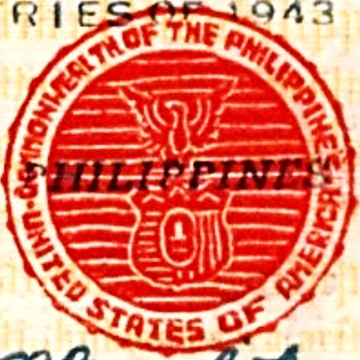
Philippine Currency of World War II
Emergency currency notes were printed by the Philippine Commonwealth Government in exile during World War II.
Many of the Anglo-Filipino soldiers not captured by the Japanese invaders when attacking the Philippines were either forming or joining resistance (guerrilla) groups. Several of these groups issued their own currency, titled Guerrilla currency, printed by using crude inks and materials.
These Emergency and Guerrilla currency notes represent history and pay tribute to the many who fought and gave their lives while defending the Philippines against Japanese invaders.
The notes were issued hastily and under exceedingly difficult conditions, and many variations were unintended issued. Collector’s interest centered on each type, variety and series, but when the extent of the issues became better known, including different dates, serial number styles, signatures and prefix letters, and to locate all the variations. In addition, numerous counterfeits of such emergency notes have been seen on the market, and sometimes the fakes have higher catalog values than the genuine notes.
The purpose of this site is to present the background for the printing of various currency notes used during WWII in the Philippines, and to promote the last publications on this topic.
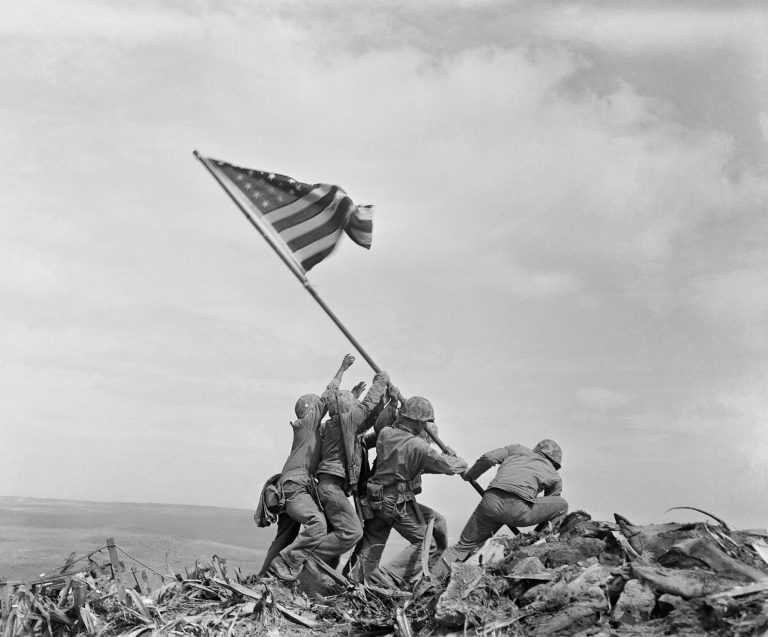
Historic photo of the raising of the American flag over Iwo Jima, taken by ©Joe Rosenthal of the Associated Press, February 23, 1945.
The Philippines
The Republic of the Philippines is a 115,831 square mile archipelago in the western Pacific Ocean, approximately 500 miles from the southeast coast of Asia, with a population of over 108 million. The entire country is divided into provinces including chartered cities as Manila, Cebu City, Dumaguete, Tacloban and Romblon. Each province has a provincial board (Governor and two elected board members).
Philippine Monetary System
In 1900, US control Act No. 52 was passed by the First Philippine Financial Commission and all banks came under the control of the United States Bureau of Treasury. The Peso was established as the unit of currency (1 Peso = 100 Centavos).
During the period of occupation, the Japanese installed a fiat currency, using the so-called Japanese Invasion Money (JIM) for daily business, see paragraph below.
After the war, the Commonwealth was restored and a one-year transition phase toward sovereignty began. In April 1946, elections were held by the first independent Philippine government, and Manuel Roxas became the first elected president. The Commonwealth ended on July 04, 1946, when the Republic of the Philippines was officially recognized by the United States.
(Just in 1967, the Peso was replaced by the Piso, 1 Piso = 100 Sentimos).
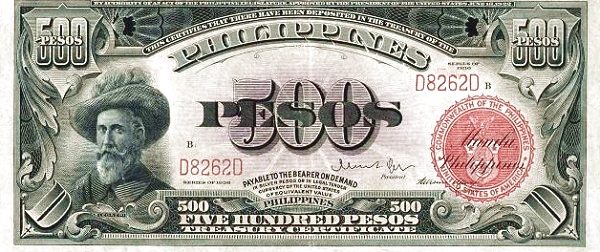
pre-war currency, 500 Pesos, 1936, P-88, ©Bank Note Museum
Japanese Occupation
On December 8, 1941, the Emperor Japanese military invaded the Commonwealth of the Philippines. Manila was declared an open city to avoid destruction. It was conquered and occupied on January 2, 1942. At the same time, amphibious landings occurred in many places including Bataan, Corregidor and Leyte. Allied forces capitulated in May 1942. The infamous Bataan Death March followed. During the war, President Manuel Quezon went from Corregidor to Australia where a Filipino government-in-exile was formed but while in exile, President Quezon died from tuberculosis in August 1944, whereupon Osmeña became President. Meanwhile, the Japanese organized a puppet government, the Second Philippine Republic, under President José P. Laurel.
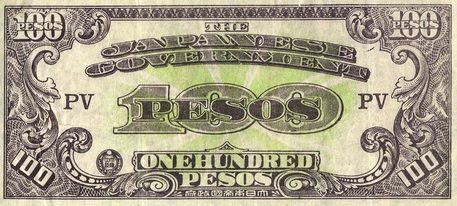
Japanese Invasion Money (JIM), 100 Peso note, 1944, P-112, 132 x 62 mm.
Philippine resistance continued, and volunteers and soldiers not captured by the Japanese formed large guerrilla detachments. One such group, the Hukbalahap (“People’s Army against Japanese”) consisted of 30,000 men; they controlled main parts of Central Luzon. On October 20, 1944, Allied troops under General Douglas MacArthur landed on Leyte and started the liberation of the Philippines. Approximately one million Filipino fighters died in battles and ambushes during the Japanese occupation.
With the invasion of the Philippines by the Japanese supplies of currency by the Philippine National Bank (P.N.B.) was interrupted, and an alternative was needed to enable daily commerce, and to prevent the collapse of payment transfers in unoccupied areas. To avoid such a situation President Quezon authorized the issue of several million pesos. However, many areas were disconnected from this currency supply and were forced to issue unauthorized currency as an emergency measure.
Philippine currency of WWII
Emergency Notes, Couponized Checks and Guerilla Currency
The outbreak of World War II in December 1941 caused a vast increase in expenditures for the Philippine military and governmental entities. As most financial offices were dependent on banking in Manila for currency supplies, the deteriorating military situation cut off the supply of currency to the provinces.
After the occupation, the Japanese soon introduced fiat notes (unbacked) for the Philippines, the so-called Japanese Invasion Money (JIM). In parallel, they were collecting all available prewar Philippine notes and coins to ship to Japan. This action, plus hoarding, resulted in a critical shortage of coins. In addition, small denomination notes were not widely accepted. The situation worsened when President Quezon decreed a three-month salary advance to all government employees. In effect, this was a bonus to those remaining at their posts. To finance the civil governments, currency was issued under various authorities. These authorities were authorized by President Quezon via radio transmissions from Washington D.C. to print Emergency Currency by the Commonwealth Government in exile. This feature of emergency currency is often mentioned within text passages on the face of the notes.
This emergency or guerilla currency was legal tender only in the areas not under control of the Japanese. How these notes were printed, for example from lead plates, is quite an interesting story as often no printing facilities were available, nor was there a permanent supply with paper or ink. In many cases carved woodblocks were used for the printing and primitive native dye was used as ink. Many different types of paper were used for note production such as wrapping paper, ledger books, newspapers, ballots, and office forms or whatever would serve the purpose. The printing process was often interrupted by dismantling printing equipment to avoid capture by the Japanese, resulting in numerous varieties of notes and patterns.
The emergency currency, regardless of where it was printed, was valid throughout the Philippines. In fact, it became the predominant currency and, in a few areas, the only currency in circulation. On some notes, the text indicated redemption after the war. At that time, they would have the same validity as pre-war P.N.B. notes. The exchange rate went back to pre-war value of two pesos per dollar.
Attempts were made to centralize the printing of currency. Early in 1942, a resolution was adopted to establish a central printing authority in Cebu City to produce uniform currency (for all Visayan Provinces and Mindanao).
For the Filipinos it was a sign of resistance against the invaders while accepting the guerilla notes for daily exchange. To be caught by the Japanese in possession of the outlawed notes often caused torture or even execution of the bearer (even entire villages population was massacred by the capture of the guerilla notes in any quantity in the valet of one man). Nonetheless, the guerilla currency notes were widespread and many of them survived the war.
Although some inter-island or inter-province acceptance occurred, the notes circulated primarily in their areas of issue, or in adjacent areas only. Despite penalties for discrimination against these notes, they never did achieve acceptance on par with regular Philippine banknotes. In some unoccupied areas, the extreme shortage of currency necessitated issuance of guerilla notes by municipal and local governments without presidential authorization. Such notes were quite often produced using crude inks and materials because of a lack of sufficient supplies.
The Japanese government outlawed the possession of emergency or guerrilla currency and declared a monopoly on the issuance of money. Draconian punishments were imposed on anyone found to possess guerrilla notes, including arrest and execution. Because of the fiat nature of Japanese-Philippine currency, the economy felt the effects of hyperinflation. Despite the announced punishments, especially in free areas or those under control of Allied forces, printing of war notes continued from October 1944 to September 1945.
Provincial - Municipal Issues
Most emergency and guerrilla currency will fit into one of two major categories - provincial or municipal issues. There are many significant differences, and a clear understanding of each category is a necessity.
Provincial Issues
Soon after the occupation had begun, it was obvious that the Philippine defenders were in real danger of being overrun. President Quezon ordered the formation of Provincial Emergency Currency Boards with authorization to print and issue notes for circulation. Most of such provincial notes were authorized by legally constituted boards or committees.
Provincial issues made up the majority of notes issued in the Philippines during this period and were officially redeemed in post-war Philippine currency.
Municipal Issues
Because paper and other supplies were severely limited, it was not possible to supply such commodities to municipal governments, local currency boards and smaller military units. They were left to meet their own needs for small change as best as they could. Most municipal currency was issued by local civilian officials with or without authorization.
Some guerrilla or military units had no other way to pay local vendors for needed supplies except in promissory notes. Often these pieces cite the backing of the United States to increase their degree of acceptance and guarantee their redeemability. These notes are much harder to find than provincial issues as they were printed in very limited quantities.
The procedure of release usually followed was to deposit the needed amount of redeemable provincial notes as security for the local notes to be issued. Such local notes were (often) not redeemable after the war, but were always exchangeable on demand by the bearer for larger denomination provincial notes, which of course were redeemable.
In addition, some private issues occurred which were needed for small exchange in a local area but without wider acceptance. Their nature is still under review, as such “notes” are more like vouchers or canteen tickets rather than real emergency currency.
Acceptance of Guerrilla Currency
Guerrilla currency was not accepted by everyone in the area where such notes were issued. The Japanese had outlawed these notes and many Filipinos were killed by torture or execution for possession of such money. On the other hand, usage of JIM notes could be interpreted as a sign of collaboration with the Japanese. Many Filipinos thus suspected were killed by their own neighbors even when no real cooperation had occurred. In all cases, acceptance of Japanese currency (JIM) called “Mickey Mouse Money” by the locals was a forced issue.
Not every municipality, city, village or guerrilla unit issued emergency currency. For example, Major James Cushing, guerrilla commander of Cebu Province felt uncomfortable issuing such currency because the population of Cebu would be exposed needlessly to penalties by the Japanese military. Instead, he used simple I.O.U.`s for procurement of needed supplies, but later 100 and 500 Peso notes were issued.
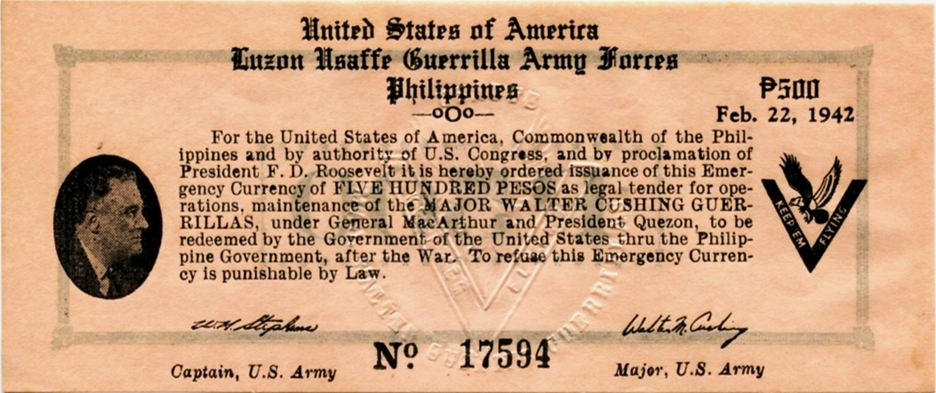
Local guerrilla money, Cushing's Guerrillas, Luzon Island, 500 Peso, 1942, LUZ-0012, S-422, 163 x 67 mm.
Production of Guerilla Notes
The creation and production of guerrilla notes was highly improvised, beginning with the design, printing method, type of ink, and the use of several available paper types. The reduction of note size, especially in 1944 and 1945, was caused by a paper shortage. Such shortages affected small issuing units while larger issuing entities did attempt to maintain standardization in size and design since they had more materials and options available.
Paper
As war conditions depleted common paper supplies, other sources had to be used. Tax and other office forms, ballots, voter registration certificates, lined school paper, brown wrapping paper, manila paper, bond (often commercially watermarked), laid paper, pink butcher paper, pages from books and cloth-reinforced paper, as well as Bais were used to print guerilla notes for circulation. The Bais paper was manufactured as a byproduct of the Bais Sugar Central (mill, see Azucarera de Carlota) in Negros Oriental Province. The paper varies in thickness and occasionally bears a watermark which weakens the paper strength. Depending on how the paper was fed into presses, the watermark could be vertical or horizontal.
Ink
Because of an insufficient ink supply, all types of chemicals were used to create ink in a variety of colors. The commonly used colors were black, bright lilac, green, blue and red. For more widely accepted provincial notes, combinations of several colors were used. Sometimes the chemicals used to wash the notes changed the original color. As a result, some security features were damaged and at times even disappeared. In other cases the ink faded, leaving the notes almost illegible.
Printing Methods and Plates
The use of metal plates is the standard method for printing notes. During the war, such plates were generally unavailable. A substitute often used was a wooden block carved into a crude plate. Another alternative was the use of rubber truck tires cut and used similar to the wooden block plates. In various locations typewriters, mimeographs and duplicating machines of all sorts were used for printing purposes. Depending on the ink and printing method, such notes can be found clearly printed and of high quality, while others appear smeared to the point of illegibility.
Security Features
Whenever possible, security features were incorporated into note designs. As the use of modern techniques was not feasible, most notes have specific border designs, printed seals, printed or handwritten signatures, countersigns, revenue stamps, a distinct color (àInk), an embossed seal or watermark. Several notes and series were printed without any security features.
Counterfeits
During the war, counterfeit notes constituted no major threat to the Philippine economy as there were simply no materials available to produce them (in high quantity). The exception is for some of the issues from Bohol Province.
Despite limited access to certain sources of material, falsification in Bohol was so rampant that it appears to have been a major wartime problem. Because there are so many different counterfeits of ₱5 and ₱10 notes, and genuine notes are so common, even here the counterfeit is far scarcer than the genuine. Most of these counterfeits are easily identified by their crude appearance. Counterfeiters did not usually have numbering machines, thus many counterfeits have crude serial numbers (see illustration below).
A few fake notes are even better in appearance than their genuine counterparts. The notes have real serial numbers, but have the wrong countersignatures for the corresponding serial number blocks. These counterfeit notes, for example ILO-0031, were produced in enormous quantities. Even so, they have about the same numismatic value as the genuine notes, except that the counterfeits are more readily available in Extremely Fine (XF) or Uncirculated (UNC) condition (for understanding the used codes, see the 2nd edition publication: known counterfeits mentioned are listed in their corresponding chapters and sections, but others undoubtedly exist and may turn up as collectors become better informed).
More problematic are the more modern counterfeits, produced years or even decades after the war, when collectors around the world showed increased interest in collecting Philippine notes. Fake notes are reported and available on auction platforms for soaring prices. This is especially true for issues from Ilocos Norte, Luzon, Masbate, Brooke’s Point (Palawan), or Samar. Contemporary counterfeits are far scarcer than their wartime counterfeit counterparts and are eagerly sought by specialists.
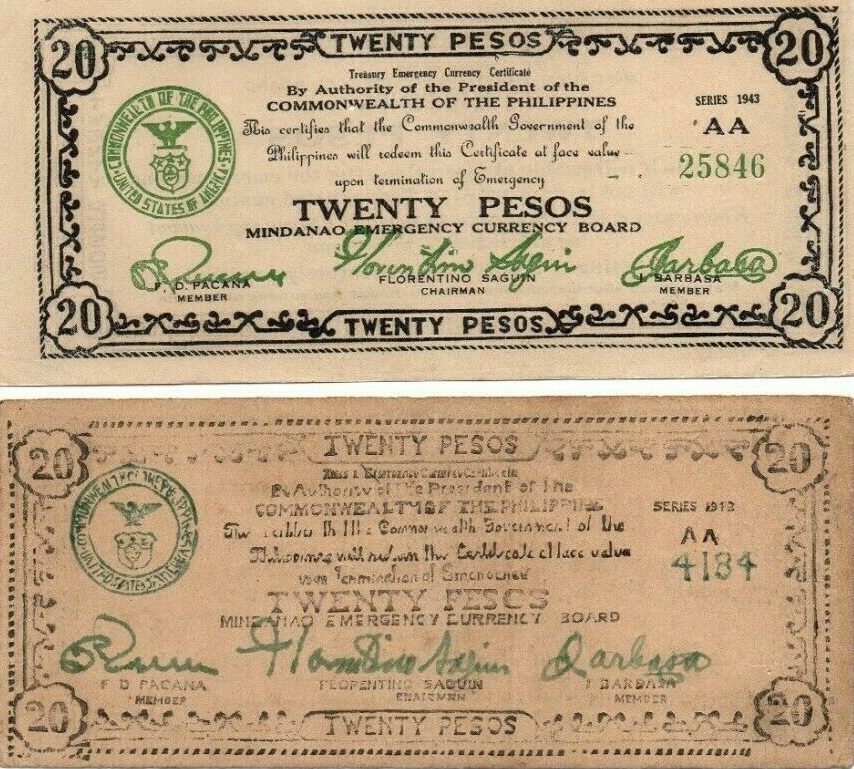
Example of a counterfeit note (genuine note and crude printed counterfeit below), Mindanao 20 Peso, 1943, MIN-0049, P-509, 159 x 72 mm.
Redemption by the Japanese Puppet Government
Soon after Japan invaded Cebu and Panay in April 1942, they were immediately confronted with emergency currency authorized by President Quezon. The Japanese Commander-in-Chief declared these currencies to be enemy currency with no monetary value whatsoever. From a military point of view this ordinance made real sense, as on both islands the USAFFE (United States Armed Forces in the Far East) had withdrawn to mountain strongholds to organize a resistance movement. By declaring the emergency currency notes worthless, the Japanese military hoped to prevent US troops from purchasing food and other supplies, and to force them to surrender. But with the USAFFE surrender a little later, the ordinance became irrelevant.
As regular Philippine currency had virtually disappeared from circulation, emergency notes became the sole medium of exchange. To ban the use of these notes would have destroyed the little vitality that remained in the severely damaged Philippine economy. The Japanese government realized this, as little effort was made to prohibit their use.
The circulation of emergency currency became an increasing embarrassment to the Japanese military and the Philippine puppet government. It was not only a violation of their military laws, but a constant reminder of their failure to discredit the former regime. What made the situation worse was that emergency notes became an obstacle to the circulation of their own military currency. Thus, the Japanese struggled to find a way to remove the offending notes from circulation.
The easiest solution was the redemption of emergency notes. As the installed Philippine puppet government had no funds for this action, the Japanese arranged to borrow the money to do so. On March 14, 1943, Jorge B. Vargas, Chairman of the Philippine Executive Commission, issued executive orders for emergency currency redemption. This announcement was widely publicized in the news media. Only pre-surrender paper notes were eligible for redemption. All notes produced by mimeograph (a substantial portion) were not acceptable. To enable redemption, notes had to be registered. A deadline of June 30, 1943, was set for registration, after which the total amount redeemed could be calculated and necessary funds sent from Manila.
Provincial as well as municipal treasurers in the larger towns were provided with rubber stamps for the purpose of registration. Other treasurers did countersign notes by pen or typewriter. After notes were registered and countersigned, they were returned to the owner until funds were available for redemption. For several reasons, many properly registered notes were never presented for redemption. Collectors may find numerous different examples, particularly the notes of Mountain Province, or Ilocos Norte, stamped.
To approve the registration, each note was stamped “PAID” in black or other colors on the face. Regulations also required that each note be stamped with suitable Japanese characters. The redeemed notes were then sent to Manila for final counting and destruction.
Despite the huge propaganda campaign which accompanied the registration period, the final result of redemption activities was disappointing for the Japanese. The results were concealed. Instead, it was announced that the redemption campaign was most successful. Since not everyone had been able to take advantage of the exchange, the period for redemption was extended, in some provinces for six months, in others without a fixed due date, as in “until further notice...” The propaganda and redemption campaigns were continued until March 30, 1944, when they were finally terminated.
The overall success of the campaign can be judged by showing the actual results for two provinces where it was most vigorously carried out. For Leyte Province, ₱242,748 were redeemed from a total in circulation of ₱2,065,410; for Negros Occidental Province, ₱443,781 were redeemed from a total in circulation of ₱4,660,980.
Redemption of Provincial / Municipal Issues by Philippine Officials
A huge amount of authorized issues of emergency currency was redeemed by the American, and later the Philippine government after the end of WWII. Several municipalities which had issued unauthorized series of currency were excluded from the official redemption campaign.
Pre-surrender vs. Post-surrender Issue Redemption
Apart from the given differentiation between Japanese Invasion Money and Emergency/Guerrilla currency, another segregation of reported issues falls into Pre- and Post-surrender issues.
The term Pre-surrender refers to the period from the outbreak of the Pacific war to the eve of the occupation by Japanese forces of a certain area or province; while Post-surrender refers to the period from the date of occupation of a certain area or province and continuing throughout the period of the enemy occupation. Therefore, pre-surrender notes were more valuable at the time of redemption than post-surrender issues since they were used as collateral to redeem post-surrender guerrilla notes.
At the end of the war, most Filipinos held enormous quantities of worthless JIM currency. The Japanese War Notes Claimants Association of the Philippines, Inc. (JAPWANCAP) began working in 1952, though it was formalized in 1953 by Mr. Al Alcede. The organization was promising (using political lobbying and lawsuits) that JIM currency would be redeemed by legal Philippine currency. To enable possible redemption of the notes, Filipino claimants had to give the JIM notes to JAPWANCAP. For these notes they received a voucher as a receipt. A small membership fee was charged for the registration certificate. Each note presented was counterstamped either on face or back by one of eight known counterstamps; various ink supplies were used for the stamping:
The American military questioned the disposition of JIM currency. In the Philippines, there were so many notes lying in the streets that it could not be controlled. In other areas outside the Philippines, when a soldier came upon cash (or any documents), it had to be handed over for possible intelligence evaluation. If there was none, the screening NCO would stamp it "examined in the field and passed - joint intelligence".
To prevent soldiers from engaging in the black market, the International Red Cross punched two holes in large groups of captured JIM notes. These holes made the notes wartime souvenirs only.
House Bill No. 647 (Senate Bill No. 51) was passed by the Philippine Commonwealth Congress on December 20, 1945, and signed by President Osmeña on Jan. 18, 1946. Another law dealing with redemption of JIM notes was Republic Act No. 369. This law enabled redemption of JIM notes issued during enemy occupation and conversion of all transactions made in JIM currency to new Philippine currency. The table provides redemption rates under the new law.
-100 % redemption for the first 500 Pesos presented,
-50 % redemption for amounts of 500 to 1,000 Pesos,
-30 % redemption for amounts between 1,000 to 10,000 Pesos,
-and 15 % redemption for all amounts higher than 10,000 Pesos.
These redemption rates were never implemented. As all other attempts for redemption failed as well, JAPWANCAP activities ended, and the organization vanished. The stamped notes were released to the public at low collector value.
Regarding the official redemption campaign by American and Philippine governments, we need to ask how post-surrender notes came into the collecting market? One source of such notes was GIs returning home bringing pieces with them. The result was a number of notes entering the collector market shortly after the end of WWII. Other notes became available decades later from local Filipinos and US soldiers who had held them as souvenirs and memorabilia from the war.
The rarity of certain issues is likely since almost all were absorbed into the new currency to help the economy. Some series were issued in extremely limited quantities and suffered loss or damage, resulting in fewer notes available to collectors.
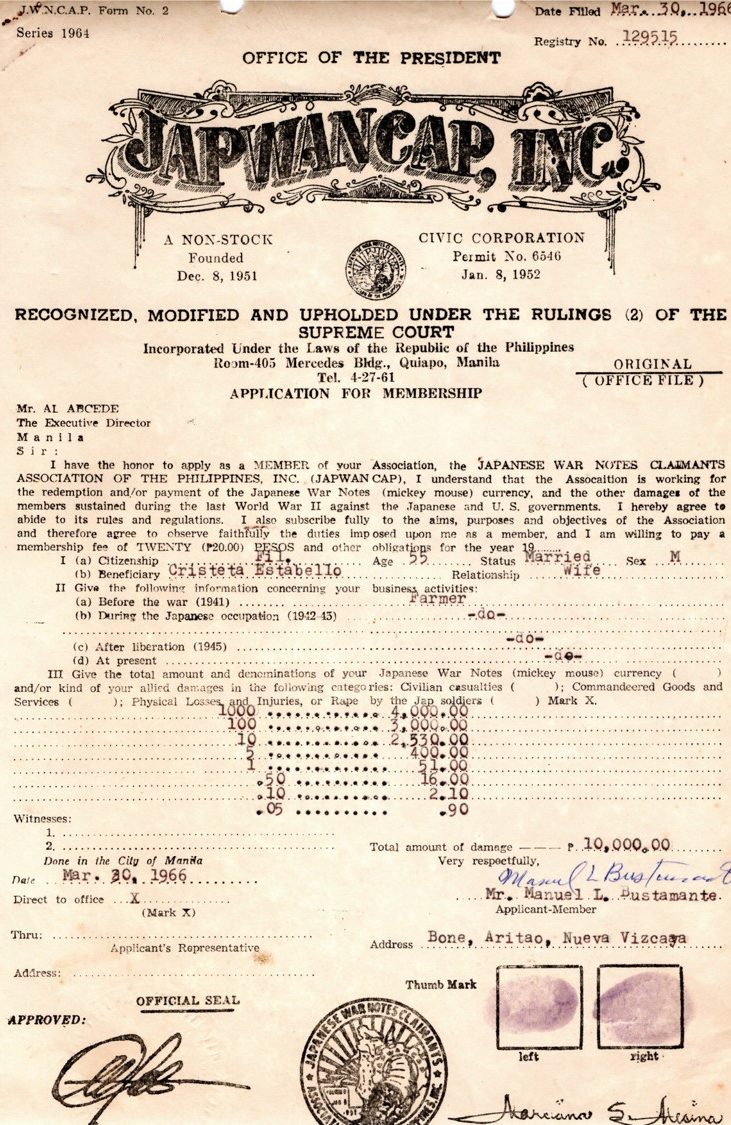
Application form for JIM currency redemption.
Collecting Philippines Currency
The fascination of collecting Philippine guerrilla paper money is often hard to explain. These notes in many cases do not look like real currency. They look more like play money, being crudely printed - so why would a collector invest money to build a collection?
These notes were issued hastily and under exceedingly difficult conditions. They represent history and pay tribute to the many who fought and gave their lives while defending the Philippines against Japanese aggressors.
Occasionally, dealers encountered collectors with massive quantities of many kinds of these notes for sale, some in excellent condition. They were available cheaply on the market. Initially, collector interest centered on one each of type, variety and series, but when the extent of the issues became better known, including different dates, serial number styles, signatures and prefix letters, collector interest further increased to locate all the variations.
Counterfeits of emergency notes such as those from Brook's Point have been seen on the market. This is an area of specialization for some who collect legitimately issued notes as well as counterfeits. These fakes sometimes have higher catalog values than the genuine notes.