In November 1941, the Japanese Empire had completed its preparations to start a war to establish leadership within Southeast Asia, and to dominate the adjacent areas. Japan's ultimate goal was complete domination in Asia and the western Pacific while at the same time eliminating all influence of western countries, for example the United States or Great Britain. The strategic objectives were the subjugation of the Philippines and the capture of the immense natural resources of the Netherlands East Indies and Malaya. The entire Japanese Combined Fleet, Army and Air Force, was directed to attack the Allied territories. Initial starting point was the attack against Pearl Harbor on December 7, 1941, and the subsequent Japanese assaults in Asia.
HISTORICAL BACKGROUND
Imperial Japanese Military Strategic Objectives
The fight of the Allied forces against tremendous military superiority heavily affected the Imperial Japanese military’s overall timetable. This resistance against the Japanese invaders on Bataan and Corregidor enabled the defenders to gain precious months for the organization of the defense of Australia and the vital eastern areas of the Southwest Pacific.
Major operations of WWII by the Japanese military were directed against the Philippines and Malaya; the invasion of British Borneo would follow soon. Further goals of occupation were the conquest of Celebes, Dutch Borneo and southern Sumatra. Japanese striking forces from these areas enabled further invasions of Java, New Guinea and the Solomons. After the fall of Singapore, northern Sumatra was occupied, and operations were carried out against Burma to cut the Allied supply routes to China. The Japanese intention was to make Singapore, Surabaya, and Manila as major bases to assist in the invasion of Australia.
If Japan succeeded, the major western powers would be forced out of their territorial positions in Asia. If this retrenchment occurred, Japan would control enormous sources of oil, cotton, rubber and other war important raw materials. Japan would then dominate East Asia, maintaining the area intact according to their dictum: “Asia for the Asians”.
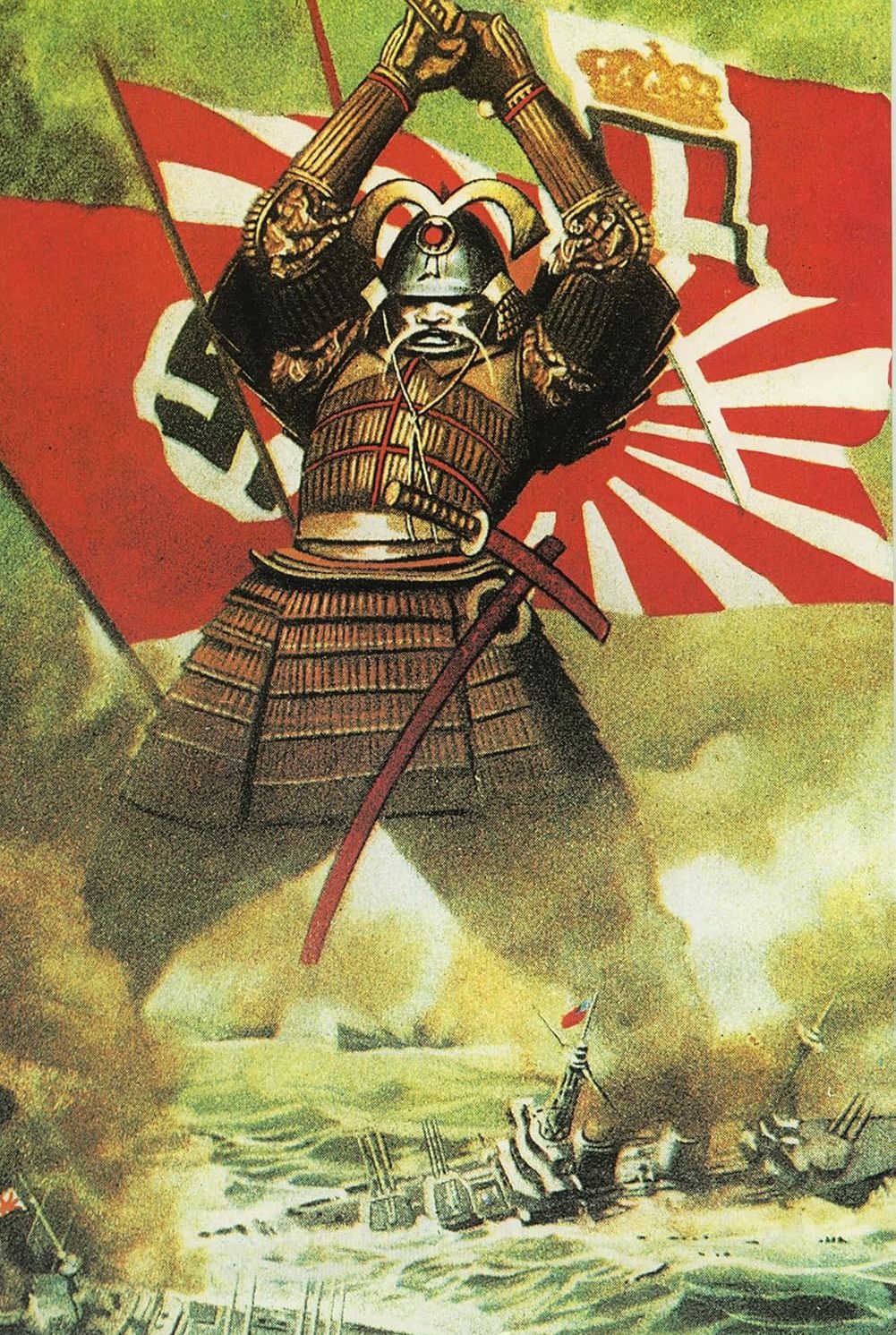
Samurai is destroying the American fleet at Pearl Harbor (7 December 1941). Japanese World War II Military Propaganda poster by Gino Boccasile.
Attack Against the Philippines
The Japanese strike against the Philippines occurred one day after the bombing of Pearl Harbor. This attack was anticipated by General MacArthur several days in advance. The Japanese attacked in enormous strength from the predicted direction, while the weak American air forces on the Philippines were not able to turn back the invaders. Attacking bombers were sufficiently guided to military objectives by sympathizers and spies.
On December 10, the Cavite naval base was heavily bombed, and simultaneously the Japanese began their invasion of Luzon Island. They landed in the south at Legaspi on December 12, under strong naval escort. The main objective was the complete annihilation of Luzon defense forces. With the main island of the Philippine archipelago under their control, the Japanese could continue to carry out an easy conquest of the remainder of the islands.
The Japanese invaded the Philippines with overwhelming strength, forcing U.S. and Philippine forces under Gen. MacArthur's command to retreat. Front detachments of Japanese Gen. Homma entered Manila on January 2, 1942. Bataan fell after bloody fighting on April 9, followed by Corregidor on May 6, 1942.
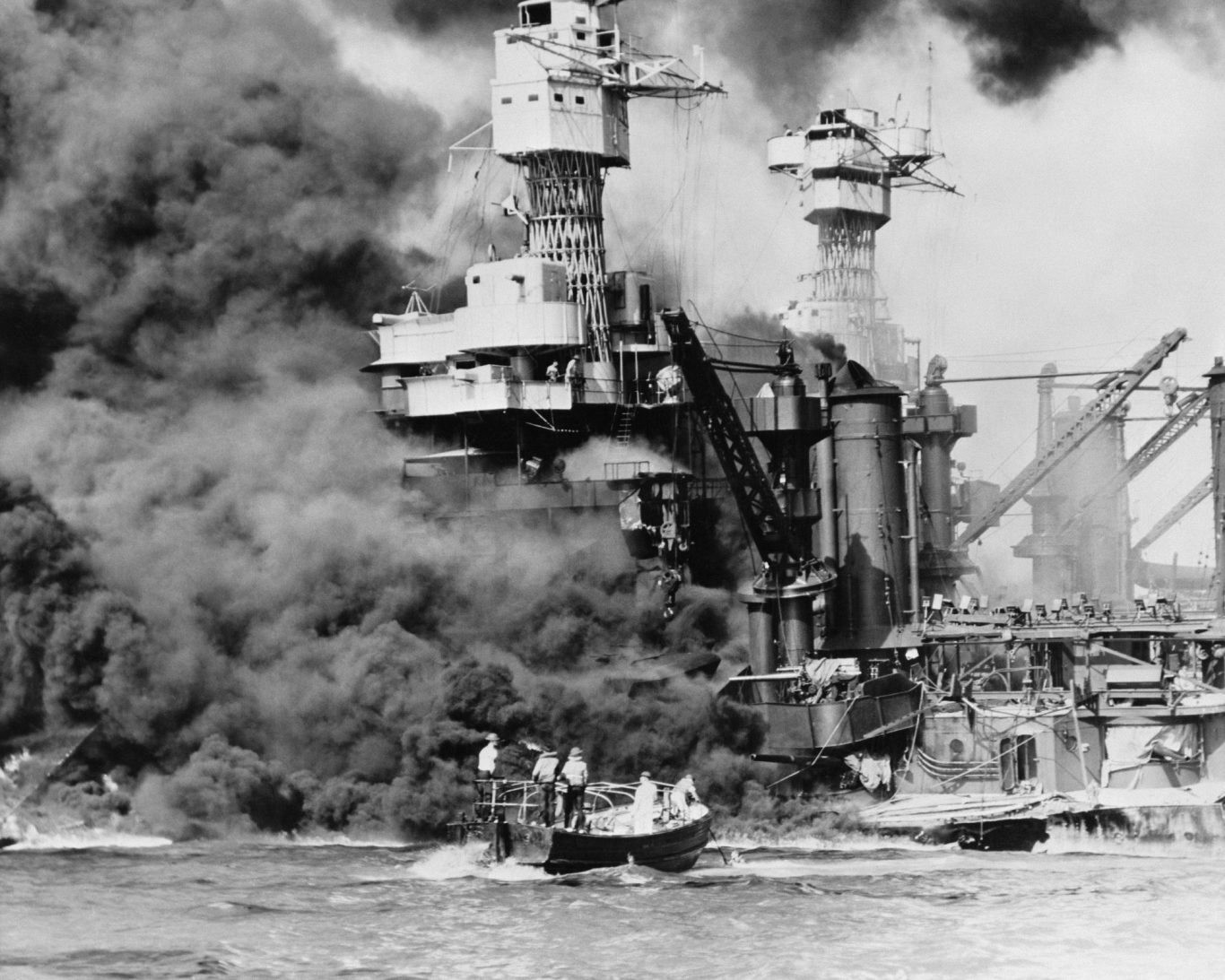
Attack on Pearl Harbour, December 8, 1941. A small boat rescues a seaman from the USS West Virginia, which is burning in the foreground.
The Philippines
The main objective of General MacArthur's planning from his departure from Corregidor in March 1942, until his return to Leyte in 1944, was the liberation of the Philippine Islands from Japanese occupation. After re-capture, these islands would be the main staging area for the final assault against the Japanese homeland.
If the Japanese supply chain would be interrupted, Japan's resources would dry up soon, and their ability to proceed against the advancing Allies would constantly decrease. Main objectives were the destruction of hostile forces in Philippine waters and seizure of central Luzon, to provide air support and naval bases for operation of Pacific Ocean Areas forces in the China coast-Formosa area.
Invasion of Leyte
The most crucial battle of the war in the Pacific was the recapture of Leyte. The outcome of the battle for Leyte would influence the course of the war against Japan. With Leyte under Allied control, all other Philippine islands would be within effective striking distance of ground and air force units. They would now be poised with full power at the inner Japanese defensive structure, and if they should break through, the Japanese homeland itself would stand dangerously exposed.
The first Allied landings were made on three small islands to protect eastern approaches of the Allied fleet to Leyte Gulf. On October 20, 1944, the largest mass of naval warships ever concentrated in the Pacific sailed into Leyte Gulf. The main forces landed in the morning on the east coast of Leyte in an 18-mile front between Dulag and San Jose.
The Japanese brought in aerial reinforcements from Formosa and Kyushu to bases in Luzon. They were able to maintain a continuous offensive against the Allied units in Leyte Gulf throughout the landing period and afterward.
While the Leyte operation was still going on, the Allied plan included landing on Mindoro and invading Luzon. The final drive to Manila was ordered on January 30, 1945. Gen. MacArthur's victorious entry into Manila occurred February 7, 1945. The last organized enemy defenses were overcome on March 3; the battle for Manila was over. On February 14, the XI Corps continued to advance and occupy Bataan Peninsula and cleared the entrance to Manila Bay. The 38th Division had secured all objectives on the peninsula by February 21. Following a powerful naval bombardment on February 16, the XI Corps launched an air and sea invasion against Corregidor, which was re-captured on February 28.
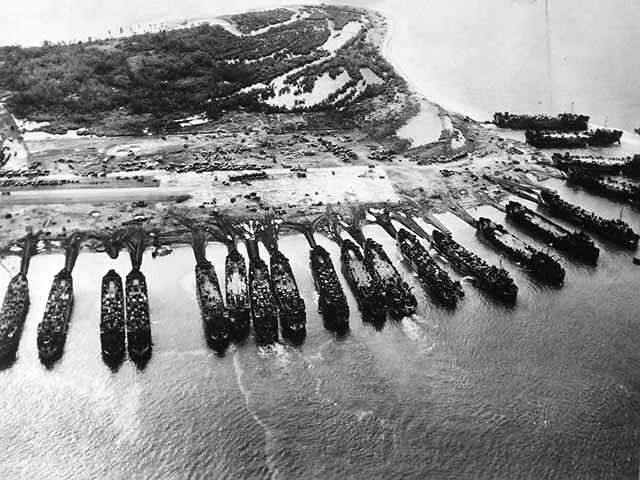
Battle of Leyte, amphibious landings/anchoring on Leyte coast.
Guerillas in the Philippines
The topography of the Philippines made it impossible for Japanese armies to garrison more than key positions, bigger towns and districts. Sparsely settled farmlands and interior mountains were left ungarrisoned by occupying troops.
Although the Japanese tried to eliminate the constantly growing numbers of small guerilla bands, the local topography proved to be a tremendous handicap for both forces. For the guerillas it prevented effective unification of strength, and for the Japanese diminished guerrilla influence. Because of their isolation, neither side could coordinate substantial attacks.
Guerrilla units initially dissipated their efforts in uncoordinated raids against Japanese troops. Such actions often brought swift and severe retaliatory measures on the public by the Japanese. On the large islands of Luzon, Mindanao and Leyte, the terrain and poor communications caused the formation of several independent guerrilla commands with intransigent leaders pursuing their own interests.
Allied Intelligence Bureau Activities
As soon as activities of Filipino resistance became known in 1942, Gen. MacArthur tried to provide direction and guidance to combine scattered groups into unified, strong and well-organized forces, even by designation and support of responsible local commanders.
In October 1942, two unsurrendered officers, Capt. W.L. Osborne, and Capt. D.J. Gause, arrived in Australia and reported to the Allied Intelligence Bureau (AIB) about guerilla activities on southern Luzon, Palawan and Tawi. In December, further detailed information concerning numerous guerilla groups on central Luzon, Leyte, Samar, Cebu, Negros, and Panay was received.
On December 27, 1942, Capt. (later Maj.) J.A. Villamor (a Philippine pilot) left Australia towards Negros to organize an intelligence net and to obtain general information about Japanese activities on the island and surrounding areas. On southern Mindanao, Col. Wendell W. Fertig, an unsurrendered U.S. officer, had become guerrilla leader. His reports indicated that this strategically placed island could be used to build up a major guerrilla base. Commander Chick Parsons, USNR, was selected to lead a secret fact-finding mission to Mindanao because of his extensive knowledge of the Philippines. He also brought cipher materials and token supplies. Upon his arrival on Mindanao and contacting Col. Fertig, he presented Gen. MacArthur's concept of guerrilla activities. Afterwards, he went on to visit other Philippine islands to contact further local guerrilla groups for cooperation To achieve this goal, the best way was to reactivate the pre-war Philippine Military Districts: the first district commanders were appointed in February 1943. Col. Fertig was appointed commander of the 10th Military District on Mindanao, and Lt. Col. Peralta for the 6th Military District on Panay. Colonel Fertig was assigned for the 9th Military District, also embracing Leyte and Samar, until a permanent commander could be selected. Similarly, Col. Peralta was nominated temporarily for the 7th and 8th Districts of Negros and Cebu.
On Panay, Thomas Confessor's civil government cooperated with Col. Peralta's guerrillas to collect voluntary contributions and taxes to support the resistance. On Mindanao, the situation was comparable. By authority of Pres. Quezon, the guerrillas issued their own emergency currency and even established a postal system. By the end of 1943, a communications network covered most of the southern Philippines, providing a framework for later extension northward during 1944.
Mindanao Guerrillas
Japanese troops held a few main cities on Mindanao, and paid little attention to the interior of the island. When the invasion of Mindanao began and the island fell to the invaders, Col. Fertig led a group of men into the hills to live underground and form a guerrilla unit. Because of his perseverance and diplomacy, he gradually won the respect of the other guerrilla leaders by the end of October 1942.
By early 1943, circumstances on Mindanao had become so favorable for the guerrillas that President Quezon authorized the creation of the Mindanao Emergency Currency Board, MECB, to issue its own guerilla notes. Supplied by Allied HQ / Southwest Pacific Area (SWPA), Mindanao guerillas eventually became the largest and best equipped in the Philippines. By January 1945, Colonel Fertig's command included a force of about 38,000 men.
When the 1945 invasion of Mindanao occurred, guerrillas on Mindanao were able to contribute substantially to military operations of the arriving Allies. They began to strike against the Japanese forces, seized the Dipolog airfield, and held it until elements of the 21st Infantry had landed. When U.S. forces chased the Japanese from Zamboanga City, Mindanao guerrilla units set up strong positions behind the retreating troops to form a wall against any further escape into the mountains. Further operations were performed by Mindanao guerrilla units until the island was cleared from occupying forces.
Negros, Cebu, and Bohol Guerrillas
The constitution and growth pattern of guerrilla organizations on these three islands was remarkably similar to that of Mindanao. On Negros, the commander of the guerrillas in central and northern portions of the island was Capt. S. Abcede. He was sent to Negros in November 1942 by Col. Peralta.
His efforts to obtain control under supervision by Peralta throughout the entire island stood in considerable opposition to the goals of other guerrilla chiefs such as Lt. Col. G. Gador in southern Negros. Major Villamor's arrival in January 1943 as representative of GHQ marked the first genuine progress toward real unification of the Negros guerrillas. Villamor organized the 7th Military District HQ, was appointed civil administrator, and secured authorization for establishment of a free civil government under A. Montelibano (pre-war governor of Negros Occidental). Upon his return to Australia in October 1943, Villamor nominated Capt. Abcede commander of the 7th Military District. Colonel Gador`s units were integrated into the overall organization and by December 1944, the strength of Col. Abcede's organization on Negros numbered approximately 13,000 men.
In Cebu, the story of the guerilla movement is primarily connected to H. Fenton and Lt. Col. J.H. Cushing. When the Japanese captured the City of Cebu and the central part of the island, many USAFFE forces escaped to the hills, taking along a considerable quantity of arms and supplies. Numerous guerrilla units were formed in the unoccupied regions to the north and south, finally combining into larger groups. A joint command was established which gave administrative responsibility to Fenton and the lead of combat activities under Col. Cushing. By the middle of 1943, critical food shortages and rapidly dwindling supplies, coupled with intensive countermeasures by the Japanese, seriously disrupted the Cebu guerrilla organization. In January 1944, Cushing was designated by GHQ as commander of the 8th Military District. On Bohol, Maj. I. Ingeniero was assigned as leader of the Bohol Area Command.
Units on Bohol, Cebu and Negros had done valuable preliminary work to assist the U.S. invasion troops. Important towns south of Bacolod were under guerrilla control. After the landings of Allied forces, the guerrillas served efficiently as scouts and guides in helping to rout the Japanese from hidden retreats and successfully performed numerous combat missions.
Panay and Adjacent Islands Guerillas
The resistance movement on Panay was unique in compared with the other provinces/islands. The guerrilla organization was built around a core of unsurrendered individuals from the Philippine 61st Division who fled to the hills immediately after the order for surrender was published. Col. Peralta, former G-3 of the division, assumed control of the main guerrilla groups (Emergency Provincial Guard / Coast Patrol Guards; E.P.G. / C.P.G). He began to expand his influence to the Visayas, to Mindoro and Palawan. In February 1943, GHQ appointed Col. Peralta as de facto commander of the 6th Military District, including Panay, the Romblon Islands and Guimaras Island. Small guerrilla units on Masbate, Marinduque, Mindoro and Palawan, lacking outstanding leaders, remained under the domination of the 6th Military District. When landing forces went ashore on Panay in March 1945, Col. Peralta's forces made a huge contribution toward eliminating the Japanese from fortified positions and beaches.
Leyte and Samar Guerillas
Until April 1943, different guerrilla leaders competed for authority on Leyte. Col. R.K. Kangleon, former commander of the Philippine 81st Infantry, attempted to consolidate numerous groups under the guidance of Southwest Pacific Area command (SWPA). In October 1943, he was appointed to lead the Leyte Area command, and by end of 1944, the Leyte guerrilla force included 3,200 men. For the first time, U.S. soldiers and guerrillas joined forces in battle on Leyte. The two largest groups north of Samar were commanded by Col. P.V. Merritt. In the south, they were commanded by M. Valley, an escapee from Bataan. In early October, GHQ appointed Col. Smith as commander of the Samar Area.
Luzon Guerillas
In contrast to other Philippine islands, the main island of Luzon was heavily occupied by Japanese military forces. Frequent and intensive clean-up campaigns by the invaders prevented any effective unification of guerrilla groups. One group formed on Luzon was headed by Col. C. Thorp, in the Zambales Mountains. In southern Luzon, three major units were commanded by Maj. B.L. Anderson in the eastern region, Maj. R. Lapham in the central region, and the "Marking’s Guerrillas" / (FAIT) in the sector east of Manila.
Maj. Anderson was contacted by SWPA agents in mid-1944. In addition to Marking’s Guerrillas and the forces of Maj. Lapham, further guerrilla units and organizations were formed, such as the Hukbalahaps in Pampanga (lead by L. Taruc), the East-Central Luzon Guerilla Area (ECLGA), units of Col. E.P. Ramsey in east-central Luzon, the Hunters in Cavite, the Fil-American Irregular Troops in Rizal and President Quezon's Own Guerillas (PQOG) in Batangas. These units were of varying degrees of structure and effectiveness.
The guerrilla situation in the northern half of Luzon remained unclear. In 1944, when command of the main guerrilla forces in northern Luzon fell to Maj. R.W. Volckmann, the situation was getting better. He divided his command into sectors, and gave each sector commander full power to consolidate and control the fragmentary outfits in his area. At the same time, a strong intelligence system was established to funnel all information of Japanese movements in northern Luzon to his headquarters.
When the Allies landed at Lingayen Gulf, guerrillas began to destroy roads and bridges, block mountain passes, and sabotage rail and motor facilities to limit any Japanese movement. Marking’s Guerrillas, led by Col. Agustin, carried out extensive combat operations in the mountain’s northeast of Manila. In northern Luzon, Col. Volckmann's units were able to clear the Japanese troops entirely from Ilocos Norte Province.
Southern Philippines
The next operations to free the southern Philippine Islands followed in rapid succession after capture of Leyte and invasion of Luzon. To ensure domination of shipping routes of the southern and central Philippines and control of the entire archipelago, Gen. MacArthur ordered quick seizure of the strategically important islands along the route from San Bernardino Strait through the Sibuyan Sea to the Verde Island Passage. The landings on Palawan occurred on February 28, 1945, at Zamboanga on March 10, on Panay on March 15, on Cebu on March 25, and on central Mindanao on April 12. Landings on Borneo were scheduled for May and June.
Visayan Passages
The important route from San Bernardino Strait to Verde Island Passage around southern Luzon under control of American forces would not only secure a vital shipping lane but would also eliminate an important channel for the Japanese to use for escape or reinforcement. Two simultaneous landings were made on February 19, on the northwest corner of Samar and on a small island just offshore. This landing initiated a series of amphibious operations to capture the islands, and on May 4, the sea route from the Lubang Islands in Verde Island Passage to the Balicuatro Islands in San Bernardino Strait was cleared.
Palawan
While numerous amphibious landings were in progress, GHQ focus was on the destruction of Japanese dominance in the Visayas and the southern Philippines. Early in February 1945, the task was the re-capture of islands bordering the Sulu Sea-Palawan region to the north and west, the Sulu Islands to the south, and Zamboanga Peninsula and Basilan Island to the east. Large scale operations were conducted against Japanese positions on Panay and Negros Occidental with Cebu, Negros Oriental and Bohol as targets to follow. The island of Palawan was of strategic importance because of its geographical position of dominating the southern Philippines and South China Sea by Allied air surveillance and superiority. Allied planes could further establish control of the straits of Mindoro, Linapaoan and Balabac. In addition, the capture of Palawan would support American forces in severing Japanese supply lines between the East Indies and the Japanese homeland. Seizure of Palawan was completed by the end of March, 1945. In mid-April, Busuanga Island northeast of Palawan, Balabac and Pandanan Islands to the south were cleared of Japanese forces. With this closing of the western exit to the Visayan Sea, the remaining Japanese forces on Panay, Negros, Cebu and Bohol were trapped.
Sulu Archipelago - Zamboanga
The Sulu Archipelago is a long chain of islands connecting Mindanao and Borneo. Allied occupation of this area combined with control of Zamboanga had completely isolated the Netherlands East Indies from the Philippines and provided further bases for future offensives against the Japanese in Borneo. To take advantage of some guerrilla actions, an airborne landing was made between March 08 - 10, on the north coast of Zamboanga near Dipolog. On March 12, the main part of Zamboanga and vicinity was seized.
With the fall of Tawi on April 6, Jolo, the central island of the Sulu Archipelago, represented the only location remaining under Japanese control. American patrol forces had landed on the island on April 2, and the main landing followed seven days later. On April 10, Jolo was seized without difficulty.
Southern Visayas
The next objectives to the liberation of Panay were Negros, Cebu and Bohol. These operations were launched in March and April 1945. Most of the surrounding larger islands were already under control of American forces. The Allied task force arrived off Panay on March 18. The attack was launched on March 20, and Iloilo was taken almost immediately. The Japanese garrison had withdrawn the previous night, after destroying approximately 70% of the city. On March 29, the 40th Division crossed the Guimaras Strait from Iloilo and landed at Pulupandan on Negros Occidental. In Bohol, the landing occurred on April 11 at Tagbiliran on the southwest tip of the island. The Japanese were forced further south, and relentless attacks finally broke organized opposition on June 12, 1945.
Mindanao
Substantial operations against central Mindanao were carried out shortly after the end of organized Japanese resistance on the Zamboanga Peninsula and Sulu Archipelago. Davao, the last major city held by the Japanese in the Philippines was seized, Valencia fell on May 16, and Malaybalay, capital of Bukidnon Province, was re-captured on the May 21, 1945.
During the early months of 1945, Japan's economic and military power was decaying rapidly with the increasing success of Allied offensives. The Imperial Japanese military command still had many divisions garrisoned in the Southwest Pacific and Pacific Ocean areas, but their effectiveness for combat activities was neutralized by blockade, isolation, and fast-dwindling supplies of food, men, material, and ammunition.
Preparations for the Invasion of Japan
When the war was being fought on Okinawa, plans were created for the largest amphibious landing in the entire Pacific war, to invade the Japan homeland itself. In early 1945, Japan was far from ready for a full-fledged Allied invasion. Plans to defend the home islands were not considered until after the fall of Saipan in July 1944. The full picture of battles, defeats and withdrawals made it increasingly probable that Japan would be invaded in late summer or autumn Victory in Europe would provide large reinforcements of men and supplies for Allied operations in the Pacific. Thus, Imperial GHQ accelerated preparations for defense of the homeland. Japanese army command was reorganized. Various homeland difficulties such as lack of forces, materials and transportation constituted some of the problems GHQ had to resolve.
Surrender of Imperial Japan
In the entire Pacific area, the Allied power dominated the land, sky and sea of the western Pacific. On July 17, 1945, leaders of the United States, Great Britain, and Soviet Union, met at Potsdam, Germany, and discussed, among other things, the acceleration of the campaign against Japan. One result was that the Soviet Union finally agreed to enter the Pacific war.
By August 15, 1945, Japan’s official notification of final surrender was received by President Truman who announced the end of the conflict in the Pacific. The Emperor of Japan made a dramatic broadcast to his people to explain and command surrender of all Japanese forces. Japan's formal capitulation ceremony took place aboard the U.S.S. Missouri, on September 2, 1945.
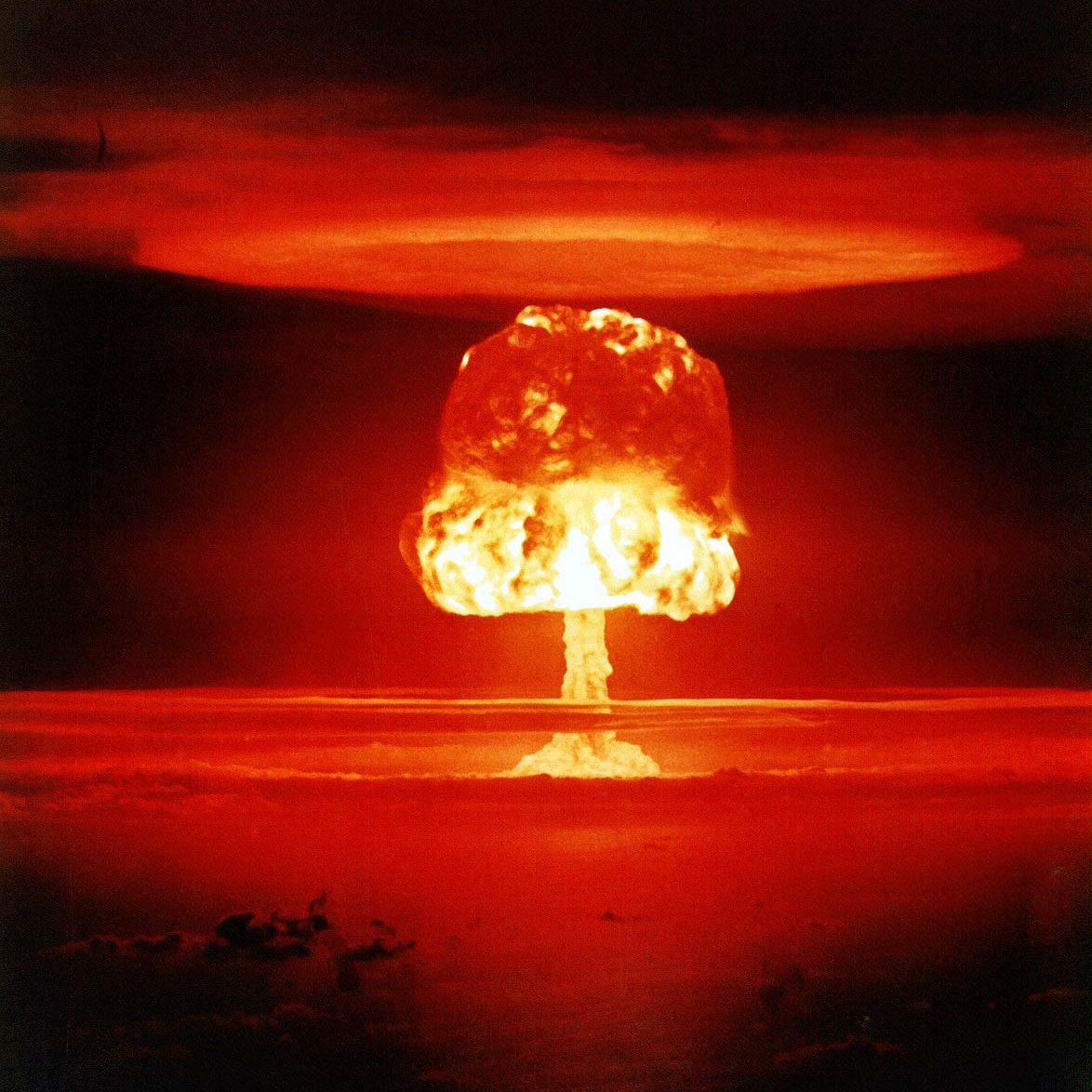
Nuclear bomb dropped on Hiroshima (Aug. 6) and Nagasaki (Aug. 9) - example picture.
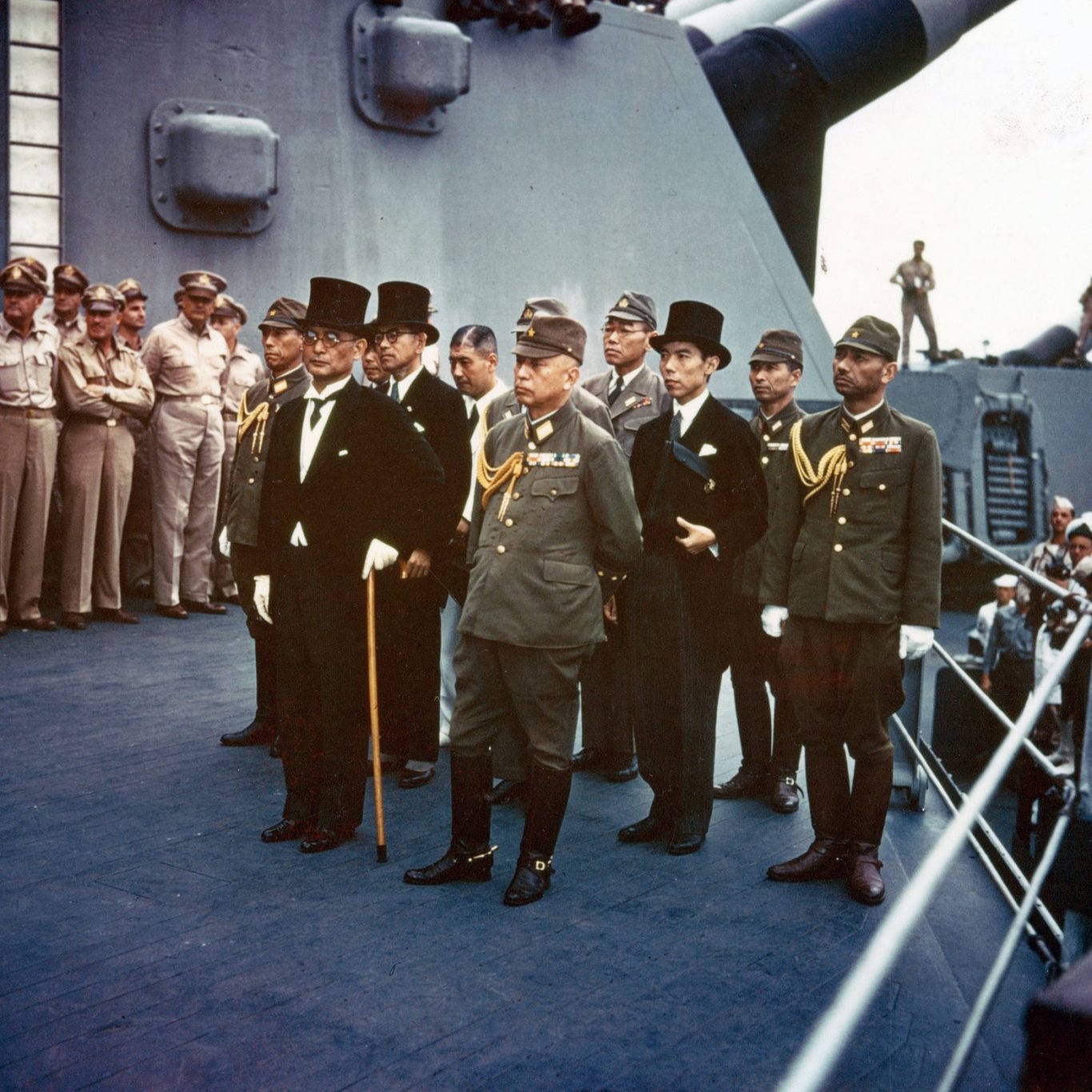
Surrender of Imperial Japan, Tokyo Bay, Sep. 2, 1945: Representatives of the Empire of Japan on board USS Missouri during the surrender ceremonies.