Hidden elements in the border device of Aklan notes, tiny countersignatures on Apayao & Cagayan notes
June 2026
As part of Panay, Aklan benefited from a relatively organized resistance structure and a larger population base. Apayao, by contrast, was one of the most remote and isolated regions of the Philippines. This contrast raises the question whether geography itself influenced the production of emergency notes.
Two series of emergency notes were issued, the first one in lower denominations only (5, 10, 20, and 50 Centavos), the second issue comprises two higher denominations (₱1 and ₱2). In sum, ₱100,000 of emergency currency was printed by guerrillas in the Coast Patrol Guards area (C.P.G.) under the command of Major Pedro Yanar. All printed notes were given to municipal treasurers, who were required to deposit an equivalent amount of Iloilo currency in a bank.
The 1st issue 5 and 10 Centavos notes bear a date of issuance, 8 Dec 1942. The other two Centavos denominations are undated. The 2nd issue notes are dated February 2, 1943. The ₱2 denomination (AKL-0006) seems to be the rarest, as no surviving example has been reported yet.
The notes were often of very poor printing quality. Many were printed on rough and very coarse brown, and relatively thick paper that absorbed the ink heavily, making some notes difficult to read.
Apart from the bold printed issue year “42” on the 5 and 10 Centavos notes (AKL-0001 a and AKL-0002 d), the printing varies considerably in the use of Roman and other font styles, as well as in the length and size of elements in the stencil. The notes are not serially numbered, and the stamped countersign on the back is often no longer visible, probably because of heavy circulation. An embossed seal is legible on most of the notes, but it seems not all notes received the seal impression (or might be modern counterfeits)
A shortage of type letters during printing appears to have resulted in a wide variety of border ornaments or layout elements on Aklan notes. For this reason, many different combinations of uppercase (A, D, M, N, O, P, S & T) and lowercase (a, c, d, f, i, l, m, n, p, o, r, t & z) letters occur in the border device, but also in the text and overall layout of the notes are some differences to find.
Because no other conventional security features such as watermarks or handwritten signatures were used (apart from the embossed seal), it is possible that the insertion of tiny letters into the border device of the 5 and 10 Centavos notes - or the use of other small decorative elements on the 20 and 50 Centavos notes - served to indicate authenticity. A close study has produced several observations concerning the use of these letters and patterns (see paragraph below).
It appears that several different stencils were used for printing the Centavos denominations, as reflected in the different subtypes (a, b, etc.) of AKL-0001 to AKL-0004. The font style varies, the length and height of the word CENTAVOS at the bottom differ, and even the typeface and size of the denomination figures in the lower corners are not always consistent. Whether these variations point to different print campaigns or even to different printing sites remains uncertain.
In addition, for the 20 Centavos denomination, the printing ink color varies considerably (see AKL-0003: usually red, while further varieties were printed in brown or lilac). This variation, together with the differing font styles and layouts, supports the assumption that the notes were not printed in a single run, but rather in several smaller batches or printing campaigns.
Since only one series was issued, either the local need for currency was sufficiently met, or further demand was covered by emergency or guerrilla notes from neighboring provinces such as Iloilo, Capiz, or Antique. On the other hand, the production of a second series may have been prevented by other circumstances, such as the destruction of printing equipment or the exhaustion of paper supplies, though no direct evidence for this has yet been found.
The postwar redemption or destruction of Aklan notes appears to have been quite thorough, as only a small number of such notes occasionally appear on auction platforms today.
Differences in Border Devices
In the printing of Aklan notes, both uppercase and lowercase letters were used, although notes with lowercase letters appear to be more common (Figure 1).
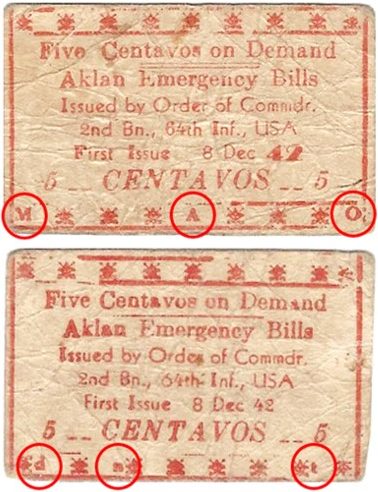
Figure 1: AKL-0001 a (S-204, upper scan) with uppercase letters in the lower border device, and AKL-0001 b (lower scan) with lowercase letters.
The tiny letters occur in different positions. In some cases, letters are missing from certain positions, for example at positions 1 (left), 2 (middle), or 3 (right) (Figure 2).
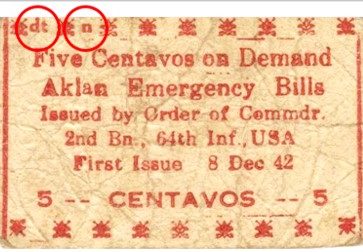
Figure 2: AKL-0001 c, with tiny letters in the upper left position, but none in the middle or on the right side.
The letters may appear either singly or in pairs (Figure 3).
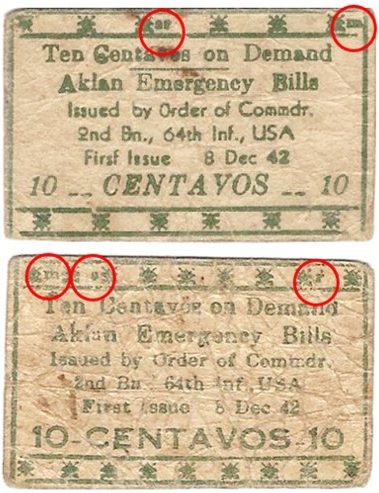
Figure 3: AKL-0002 a (upper) and AKL-0002 b (lower scan) (S-205) with single letters or pairs of letters.
Only one note has so far been found with tiny letters in both the upper and lower border device. Normally, the letters appear either in the upper or in the lower margin, but not in both (Figure 4).
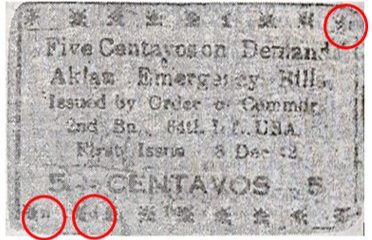
Figure 4: AKL-0001 d (photocopy from the Neil Shafer Collection) with tiny letters in both the upper and lower border device.
For the higher denominations, 20 and 50 Centavos (AKL-0003 and AKL-0004), a gap is found in the middle of either the upper (Figure 5) or lower (Figure 6) border device, where one asterisk is missing.
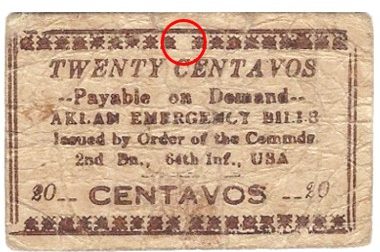
Figure 5: AKL-0003 c (S-206); gap in the asterisks at the center of the upper border device.
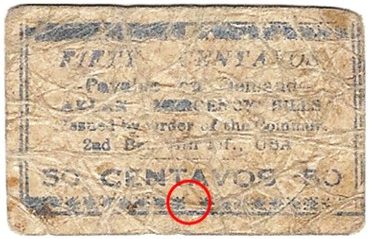
Figure 6: AKL-0004 a (S-207); gap in the asterisks at the center of the lower border device.
For both AKL-0003 and AKL-0004, no evidence has yet been found of tiny letters within the border device. The asterisks in these border designs are placed so closely together that no letters could easily be inserted. By contrast, the asterisks on AKL-0001 and AKL-0002 may be arranged either with relatively wide spacing or much more closely together (Figure 7).
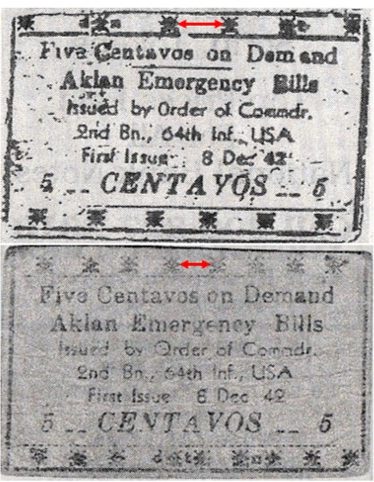
Figure 7: AKL-0001 b, (photocopy from the Neil Shafer Collection) showing wider gaps (upper) and narrower gaps (lower scan) between the asterisks.
For the usage of these tiny letters no clear pattern was revealed and the purpose of the use (as safety feature, or to prove genuine notes) remains unclear.
APAYAO
The Centavo notes of the Apayao Second Issue are woodblock prints bearing the title APAYAO and two vertically printed serial numbers at left and right, in purple or black ink. After the initial printing, each note received a black hand stamp containing the text Payable After the War together with the names and titles of the three members of the Currency Committee: Milton Ayochok, Deputy Governor; M. Medina, Treasurer; and F. H. Enciso, Auditor. In some cases, red initials appear near Ayochok’s name and are usually assumed to represent his initials. Further initials beside the left and right serial numbers are generally taken to represent Medina and Enciso.
The reverse is similar in design but lacks the black stamp. It carries a vertically written control number and the letters B or JBT, applied by hand stamp. These appear to relate to the clerk who wrote the control number. JBT is not found on 5 Centavos notes, but does appear on low-numbered 10, 20, and 50 Centavos notes.
Considerable variation in ink color is seen, especially on APA-0022 and APA-0022 A, where the face and back may appear in very different shades, including lilac, brown, lavender, blue, or red. Notes with JBT beside the control number are known up to SN 1128. Later examples show only the prefix-suffix B beside the control number.
Centavo notes commonly carry multiple initials or signatures in addition to the vertical serial numbers, including faint markings near the names of M. Medina and F. H. Enciso, often in blue, black, or red ink.
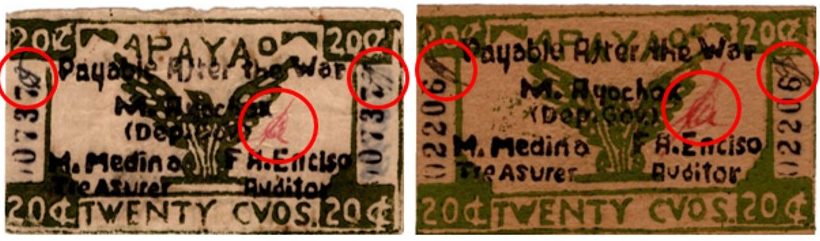
Figure 8: APA-0023 (S-105)
On Centavos notes are commonly two i.e. three signatures present (right aside of the vertical serial number on the left and right margin) and one closely to the central eagle i.e. to the name of F.H. Enciso (Auditor (in red) (Figure 8).
Peso Values
The Peso notes of Apayao bear the Philippine national emblem, showing an eagle with outstretched wings. The emblem appears in red on the ₱1, ₱2, and ₱5 notes, and in green on the ₱10 note. The title APAYAO LEGAL TENDER appears prominently, and two serial numbers were applied by a hand numbering device.
Two slightly different woodblocks were used for both the ₱1 and the ₱2 denominations, resulting in observable differences in the vertical ornamental lines and the thickness of the printed denomination words and titles. Two green-ink varieties are also known for the ₱2.
As with the Centavo notes, each Peso note received a black stamp after the initial printing, containing the titles and signatures of the three members of the Currency Committee, as well as the embossed seal of Governor M. Ayochok at the center.
The reverses differ widely in layout. On low-numbered ₱1 and ₱2 notes, the control number is flanked by JBT on both sides. Later examples, and all ₱5 and ₱10 notes, instead show the combination B-B to the left and right of the control number.
On the Peso denomination notes usually three signatures are present (always behind the serial numbers on left and right side – but can be very indistinct and hard to find). The third one is commonly in red ink and to find right below of the Philippines / P.N.B. emblem or closely to the name F.H. Enciso (Auditor) (Figure 9).
The usual pattern seems to be:
- Left serial number: signature / countersign of Treasurer M. Medina
- Middle: signature / countersign of F.H. Enciso, Auditor
- Right of serial number: signature / countersign of Governor Milton Ayochok
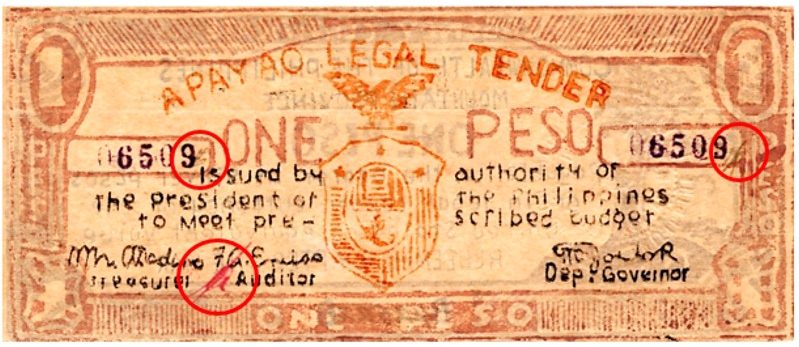
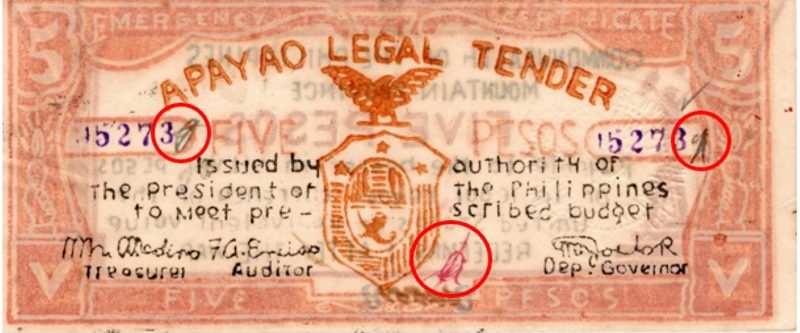
Figure 9: APA-0025 b (upper) and -0027 a (lower scan).
CAGAYAN
The Centavos notes of the Second Issue are characterized by the title EMERGENCY TREASURY CERTIFICATE, embossed seal, revenue stamp, and printed signatures of the officials. The denomination itself appears only on the revenue stamp. The border devices also contain embedded letters, such as G, A, M, and S, whose meaning remains unknown.
The larger Peso notes follow a similar principle, with distinct revenue stamps, embossed seals, printed signatures, and serial numbering. Countersigns and initials often appear near the names of the officials.
During the production of the Fourth Issue, increasing Japanese military activity forced the provincial government to move from Tuao to a barrio in the municipality of Rizal. Later developments compelled the government to leave Cagayan altogether and re-establish itself at Kabugao. While this issue was being printed, radio contact was established between the provincial government and President Quezon, who officially approved the actions of the Cagayan Currency Board.
The notes of the Fourth Issue were printed from hand-carved woodblocks. Several types of ink were used, including duplicator ink and diluted house paint, resulting in considerable variation in color, as well as many over- or under-inked examples.
The Fourth Issue consists of 3 groups of notes:
- Medium Size Centavos notes, 10, 20 and 50 Centavos;
- Small Size Centavos notes, 1, 5, 10, 20 and 50 Centavos;
- Peso denominations of Standard Size, ₱1, ₱2, ₱5, and ₱20
Medium Size Centavos Notes (CAG-0042 to -0044)
The medium-size Centavos notes were printed first. Later, smaller-sized Centavos notes were introduced to save paper. The serial numbers generally continue across the issue, except in the 50 Centavos denomination, where the numbering ranges overlap. Gaps in numbering appear to have resulted from the intermixture of varieties.
All Centavos notes in this group share the same basic design. The title CAGAYAN appears at the top, with the denomination written out at the bottom and shown as numerals at each side. The central design consists of a native hut, palm tree, pine tree, and sun. Each note bears two serial numbers. A rubber stamp with the text PAYABLE AFTER THE WAR was applied, together with the names of Governor Adduru and his two officials. Handwritten initials are often found adjacent to these names. The back is like the face, but without serial numbers or rubber stamp (Figure 10).
Small Size Centavos Notes (CAG-0050 to -0054 A)
These smaller Centavos notes follow the same basic design as the medium-size group. A single serial number, usually in purple, was applied by hand with a manual numbering device. Although much smaller in format, the designs are so similar that it is likely that the same wood carver prepared the blocks for both groups.
The text and names correspond to those on the larger notes but are mostly rendered in lowercase letters and with abbreviations. Handwritten initials are often found near the printed names. The reverse is like the face but lacks serial numbers and the rubber stamp. On early printings of the 10 to 50 Centavos notes, serial numbers may appear on the back. On the 50 Centavos notes, handwritten control numbers are found on the face.
Some notes were later counterstamped, signed, and dated for purposes of registration or redemption. On some of these stamps, the abbreviation Troas. appears as a misspelling of Treas. (Figure 11).
Peso denominations (CAG-0055 to -0059 A)
The standard-size Peso notes include the denominations ₱1, ₱2, ₱5, and ₱20 (CAG-0055 to CAG-0059 A) (Figure 12).
The title CAGAYAN appears at the top, with an eagle with outstretched wings at the center and the denomination written out along the bottom line. All notes show denomination numerals in the corners. A rubber stamp reading PAYABLE TO THE BEARER AFTER THE WAR was applied after printing. This stamp also contains the titles and facsimile signatures of the Governor and his officials and appears in either black or green ink. Each note bears two stamped serial numbers, often accompanied by nearby handwritten initials. The reverse of each denomination differs in layout and border design, some examples being quite elaborate. At the center appears the text, in black or green:
COMMONWEALTH OF THE PHILIPPINES, CAGAYAN, issued by authority of the President of the Philippines and the Provincial Board of Cagayan, Refusal to accept this note is punishable by law. A four- or five-digit handwritten control number is usually found near the bottom line, often together with a nearby handwritten initial.
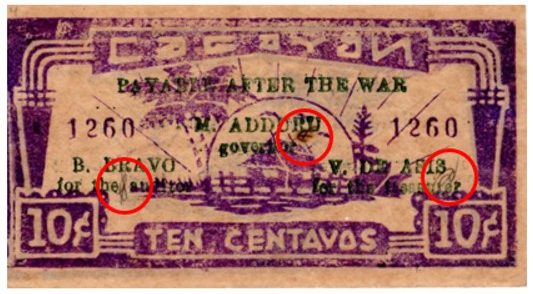
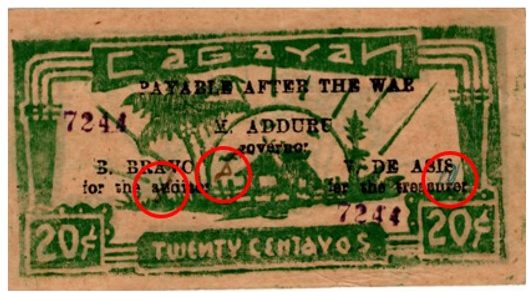
Figure 10: CAG-0042 and CAG-0043, bearing small countersigns.
Initials / Countersign to find closely the stamped name B. BRAVO (left) near the word ‘Auditor’ or directly on it, the same for the name V. DE ASIS on the word ‘Treasurer’ and on third place, usually very tiny sign and thus easily overlooked, set closely to the name M. ADDURU (Governor).
For the following issues the same scheme is applied that all three people are handwritten sign all (!!) notes, or vice versa, all clerks are using the same initial for the corresponding role they are signing.
For counterstamped Centavos note (with the scheme):
Registered
Countersigned
Prov. Troas (and the date applied at right side, vertically),
one signature is always present (while four different signatures of clerks were identified).
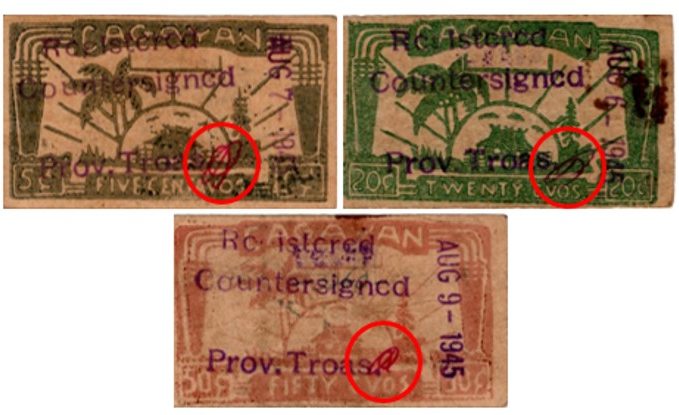
Figure 11: Backside scans of CAG-0050 to -0052, with stamps and countersignatures.
Starting with the Peso denomination (CAG-0055), at least two signs are commonly applied. (below the serial numbers) (Figure 12).
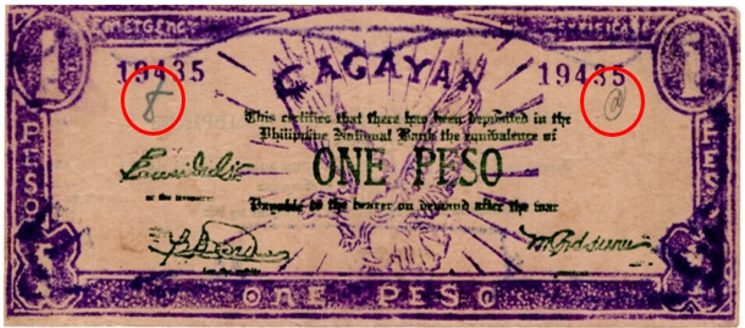
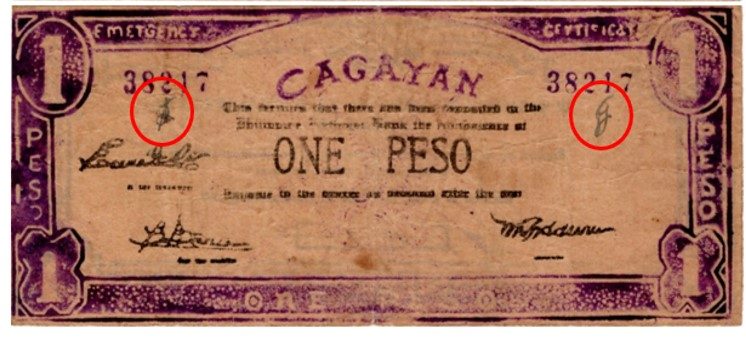
Figure 12: CAG-0055 (upper) and -0055 A (lower scan).
On the right side, the signatures are variable but on the left side it seems always the same signature / countersign was applied.
Variances in design elements and countersigns of Negros Island banknotes
March 2026
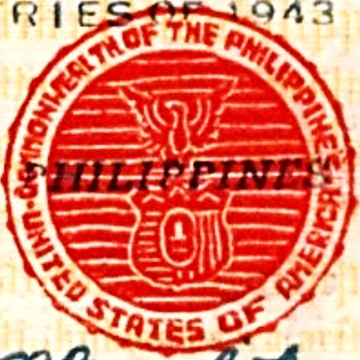
Banknotes issued by the Negros Emergency Currency Board (NECB) bear a circular seal on the right side of the face. To date, ten seal varieties are known. Although all share the same basic design, they differ in color, size, and in the style of the word “Philippines,” which appears in black across the center of the seal.
In the 1943 series, four series letter-digit combinations (A1 to A4) were used for denominations below 20 Pesos. For the ₱20 denomination, only A1 to A3 were issued. The ₱50 and ₱100 denominations were issued only with the A1 and A2 combinations, while the ₱500 denomination used a single series letter, A, without an accompanying digit. The only exception to this pattern is the ₱1 denomination (NEG-0005), for which A1, A2, and A3 were issued together with B1 and C1 to C4.
For the lower denominations of the 1943 series (1 and 5 Pesos; NEG-0005 and NEG-0007), clerk initials were applied either on or near the printed Provincial Auditor’s signature. On the ₱10 denomination (NEG-0008), clerk initials are typically found on or near the Acting Treasurer’s signature, while on the ₱20 denomination they appear on or near the Chairman’s signature.
Only one sample note has so far been identified bearing two clerk initials (Figure 4), a rarely encountered anomaly, as lower denominations normally carry only a single clerk initial.
Higher denominations, such as NEG-0010 to NEG-0012, no longer carry clerk initials but instead bear handwritten signatures of the responsible officials on the reverse. On the ₱50 notes (Figure 5), two handwritten signatures - those of the Acting Treasurer and the Provincial Auditor - appear at the bottom of the note. On the ₱100 notes (Figure 8), a single handwritten signature of Chairman Alfredo Montelibano is found at the bottom. The ₱500 notes (Figure 9) bear handwritten signatures of all three officials, with Montelibano’s signature usually positioned at the top and the other two officials’ signatures at the bottom.
Beginning with the 1944 series and the 1 Peso denomination (NEG-0025), clerk initials again appear on or near the Provincial Auditor’s signature. For the NEG-0025A and NEG-0025B varieties, the initials are typically found on or near the printed Chairman’s signature. Starting with NEG-0037, the placement of clerk initials becomes more variable, but generally remains close to the Provincial Auditor’s signature. On the higher denominations of ₱10 and 20, clerk initials are commonly positioned near either the Chairman’s or the Acting Treasurer’s signature. This practice continued through the 1945 issues.
Considering that all 50 to 500 Peso notes of the 1943 series required handwritten signatures from the responsible officials, the signing process must have been extremely time-consuming. According to the Estimated Number Printed (ENP) figures published in Philippine Emergency and Guerrilla Currency of WWII, 2nd Edition (2024), the quantities requiring signatures amounted to approximately 40,000 notes for NEG-0010, 15,100 notes for NEG-0011, and 1,700 notes for NEG-0012.
The wide range of clerk initials observed throughout the series may reflect the involvement of multiple individuals responsible for the authentication process, naturally resulting in variations in handwriting style and format.
In addition, variations in ink tone and application may have been influenced not only by the materials available, but also by differences in ink preparation, dilution, or printing conditions at the time. Such production characteristics provide an additional layer of insight into the manufacture of these notes.
During the investigation, another printing error was identified on NEG-0025 D4 and NEG-0038 D3, where the title of the Provincial Auditor was misspelled as “Prov. Auditor” as “Pov. Auditor (Figure 1).
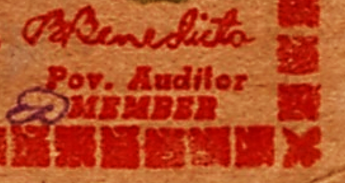
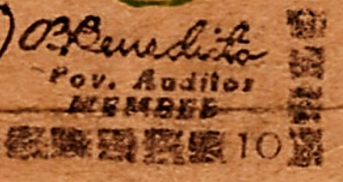
Figure 1: Misspelling error in Prov. Auditor, given as Pov. Auditor, on NEG-0025 D4 and NEG-0038 D3.
Different Seal Types
Across the various denominations of the 1943 and 1944 issues, several seal varieties have been identified. These differences involve both the design and the size of the eagle positioned at the top of the seal. In some cases, the eagle itself is smaller or larger, while in others the wings appear either more slender or more extended (a - e).
By the time the 1943 500 Peso issue (f) was produced, the seal design appears to have become more standardized, with the same or a very similar seal subsequently used across denominations. Later variations are generally limited to seal color. Although no 1945 issue seal is illustrated here, it is essentially the same as that used on the 1944 issues.
Apart from the eagle design, the size and appearance of the inner emblem also vary. The emblem may be small (a), very small (b), or broader in design (c–e). The filling and hatching patterns also differ. For example, in some varieties the upper portion of the emblem is filled while the lower portion remains unfilled. The hatching style evolved between earlier and later seal varieties. Beginning with the seal used on the 1943 500 Peso note (NEG-0012), the design appears to be more consistent, with only minor variations observed thereafter.
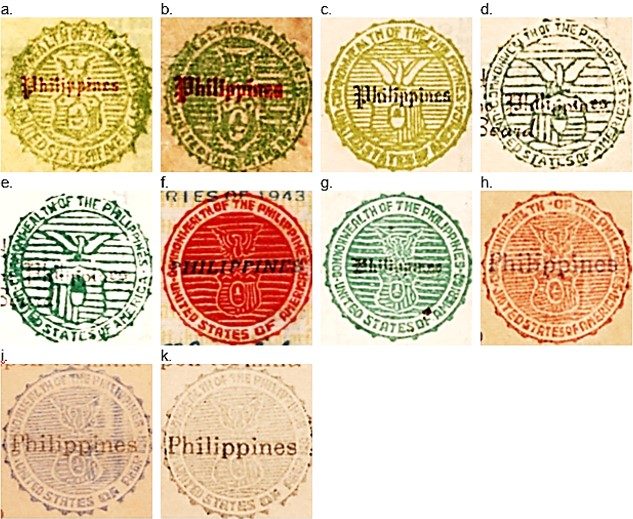
Figure 2: Variances of province seal - differences are present in emblem size and design as ell as in the eagles wing length.
Variations in Signatures
During the investigation of Negros note varieties, at least 40 different clerk initials were identified, with signatures 17 and 37, as well as 8 and 41, appearing to be identical (Figure 3). Additional variations may exist but have not yet been documented.
The signatures and initials are generally presented in their actual size, although a few examples have been enlarged slightly to improve visibility and facilitate comparison.
In some cases, apparently different signatures may represent abbreviated forms of the same clerk’s full signature or initials. For example, a clerk may have omitted an initial letter that appears in a more complete version of the signature. This may be the case with examples 11 and 38, where a possible “Ma” prefix appears to have been omitted.
Other initials display strong similarities and may represent the same individual. Examples include signatures 13 and 23, 20 and 28, and 27 and 31. The initials represented by 20 and 28 may possibly be attributable to Chairman Montelibano, although this remains uncertain.
In general, the variety of clerk initials decreases in the 1944 issues and appears to remain relatively stable throughout the subsequent 1945 series.
Should additional sample notes bearing previously undocumented initials become available, they would be most welcome, so that this overview may be further expanded and refined.
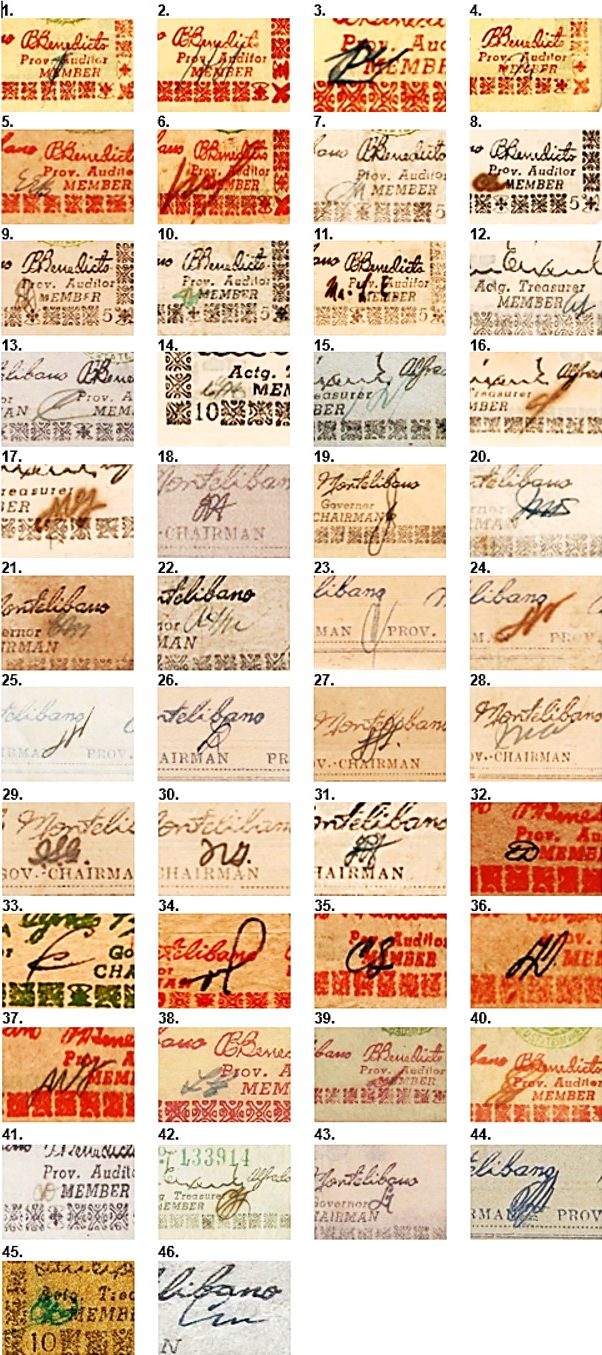
Figure 3: Overview of countersigns applied on Negros Island notes.
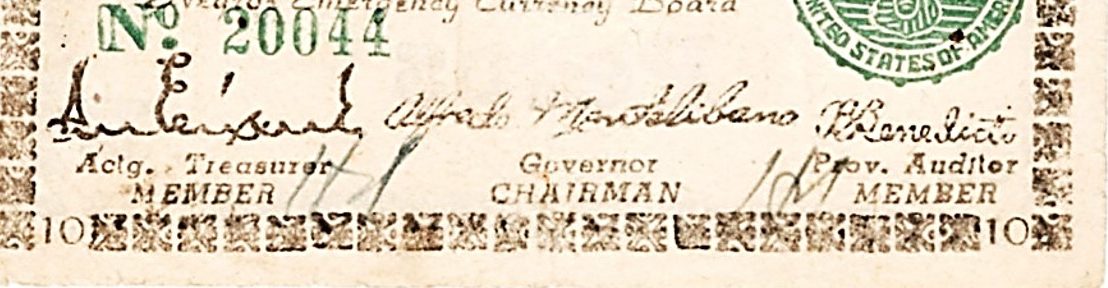
Figure 4: Two clerk initials / signs (see No. 2 and 15 in the overview above) appear on the same note, whereas only a single sign is normally present.

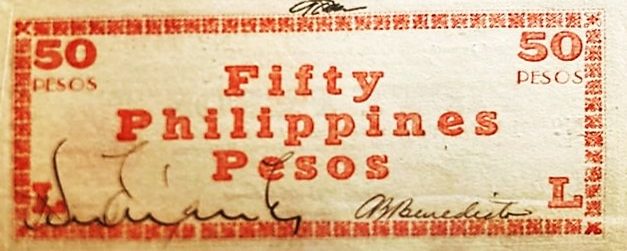
Figure 5: Two handwritten signatures of the Acting Treasurer and the Provincial Auditor appear at the bottom of a 50 Peso note (NEG-0010). The upper note also shows a rarely encountered set of initials at the top, possibly attributable to Montelibano; this, however, remains uncertain, although the initials bear a strong resemblance to No. 7., and see Figure 3).

Figure 6: Handwritten signature of the Chairman at the bottom of a 100 ₱ note (NEG-0011).
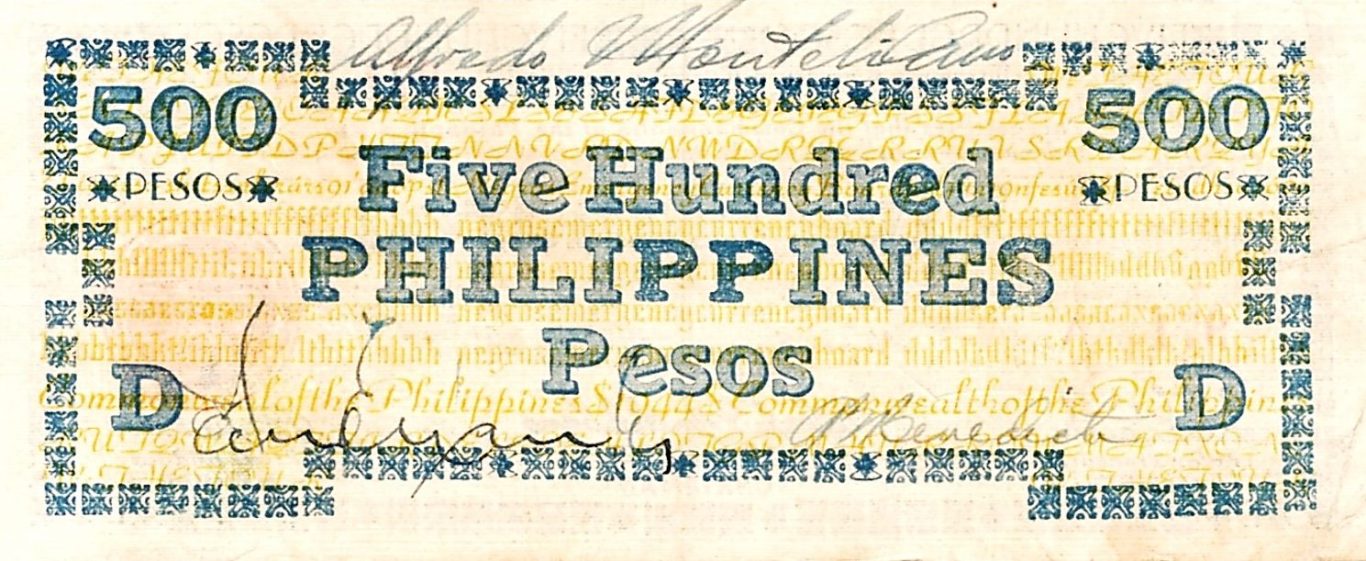
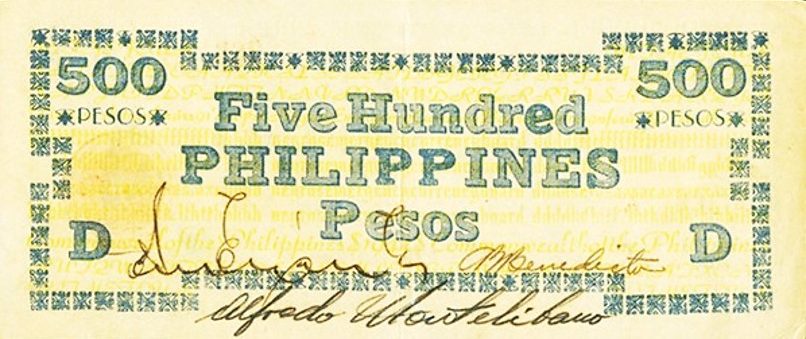
Figure 7: Handwritten signatures of all three officials on the reverse of a 500 Peso note (NEG-0012). The Montelibano signature is normally placed at the top of the reverse, but in exceptional cases it may also appear at the bottom, as on the lower note illustrated here.
Paper Types
During the investigation of seal varieties, clerk initials, and other note characteristics, it became evident that a variety of paper types were used in the production of Negros notes. Further descriptions and definitions of the paper types are provided.
No clear relationship was found between paper type and denomination or series. Instead, the evidence suggests that whatever paper was available at the time was used for note production.
Bais paper
The Central Azucarera de Bais in Negros Occidental was one of the largest producers of raw sugar in the province and a major source of so-called Bais paper. This paper was made from the remnants of the sugarcane production process (bagasso), mixed with coarse paper pulp.
Bond paper
Bond paper is a high-quality, durable writing paper similar to bank paper, but usually of greater weight. The most common weights are 80 g/m² (20 lb) and 90 g/m² (24 lb). The term derives from its original use for documents such as government bonds. This type of paper may at times contain rag-fibre pulp, producing a stronger, though somewhat rougher, sheet.
Lancaster Bond paper
A type of bond paper manufactured by the Chicago firm Childs & Smith. In 1960, the company was acquired by the Mead Corporation, and in 2001 by the Fox River Paper Company, before pro-duction ceased later that same year. Throughout its history, the company produced high-quality papers with cotton-fibre content, including bond, ledger, index, and onion-skin papers.
When checking for a watermark (if present), one can often observe tiny blue and red speckles in the paper.
Linen Bond paper
See Bond paper. Linen bond paper has a woven, linen-like surface texture and was commonly used for business letterheads, formal correspondence, elegant invitations, and personal stationery. In some cases, the texture is present on only one side.
Manila paper
Manila paper is a relatively inexpensive type of paper, generally made through a less refined process than other paper types. It was originally produced from manila hemp - Musa textilis (also known as abacá). Before the end of the twentieth century, papermakers largely replaced abacá fibres with wood pulp, which was less costly to source and process. Despite this change in raw material, the name and characteristic color remained in use.
Manila paper is buff-colored, and its fibres are often visible to the naked eye. It is approximately as strong as kraft paper, but offers better printing qualities, especially in pigment retention.
Premier Bond paper
See Bond paper. Premier Bond paper is generally thicker and of higher density or weight.
White / Brown paper
White paper is made from high-quality raw materials and is bleached, traditionally with chloride or oxygen-based processes. Its bright white color provides strong print contrast for both color and monochrome documents. Smooth, relatively thick, and opaque, this type of paper is well suited for high-quality printing.
Brown paper is essentially similar in composition, but remains unbleached.
Date Print Issue
The printed date on many 1943 Negros notes exhibits noticeable variation in spacing, alignment, sharpness, and ink intensity. These differences may reflect variations in the printing process or in the conditions under which the date was applied.
The variations are most pronounced on the 1943 issues and appear less frequently on the 1944 and 1945 issues. No consistent pattern has been identified indicating that specific series combinations such as D2, E2, or F2 are always affected by date-print irregularities (Figure 8).
Following adjustments to the printing plate or stencil, the issue appears to have largely disappeared. Only minor date-print defects are known from the 1944 series, specifically among the D4, E3, and G3 combinations. Additionally, on series carrying the digit “1” - for example C1, D1, or E1 - the “44” in the printed date often appears somewhat indistinct, possibly as a result of over-inking.
For the final issue, only one example has been observed in which the font size of the date differs slightly from the standard format. On this note, the digit “5” in “1945” appears slightly enlarged and somewhat separated from the remaining digits.

Figure 8: Variations in issue year font type and letter / digit size, present on NEG-0005 C4, NEG-0008 A4 and NEG-0009 A3. Partially printed year of issue (SER in SERIES, just the upper half) for NEG-00012.